A Parent’s Guide to Early Intervention and Informed Decisions
“Just wait. Your child will talk when they are ready.”
Many parents hear this when they express concerns about their toddler’s communication.
Perhaps your child understands familiar instructions but only says a few words. Maybe they point or pull you towards what they want instead of speaking. Family members may reassure you by saying:
- “Boys usually talk later.”
- “His older brother was the same.”
- “She is growing up with several languages.”
- “Once school starts, the words will come.”
These comments are usually well-intentioned. However, waiting without seeking professional advice may delay important support.
Some late talkers do catch up naturally. Others continue to experience speech, language, social communication or broader developmental difficulties. The challenge is that it can be difficult to know in advance which children will catch up and which children will need help.
Early assessment is not about rushing to label a child. It is about understanding how your child communicates, identifying their strengths and needs, and deciding whether additional support could help.
What Is the Difference Between Speech and Language?
Parents often use the term speech delay whenever a child is not talking as expected. However, speech and language are not exactly the same.
Speech refers to how a child produces sounds and words. A child may know what they want to say but have difficulty pronouncing sounds clearly.
Language refers to how a child understands and uses words, sentences, gestures or other forms of communication to share ideas and needs. Language can be expressed through speech, signs, pictures, writing or communication devices.
A child may therefore have:
- A speech sound difficulty
- An expressive language delay
- A receptive language delay
- Difficulties with both understanding and using language
- Broader social communication or developmental differences
A professional assessment helps determine which area—or combination of areas—may be affecting the child.
What Does “Late Talker” Mean?
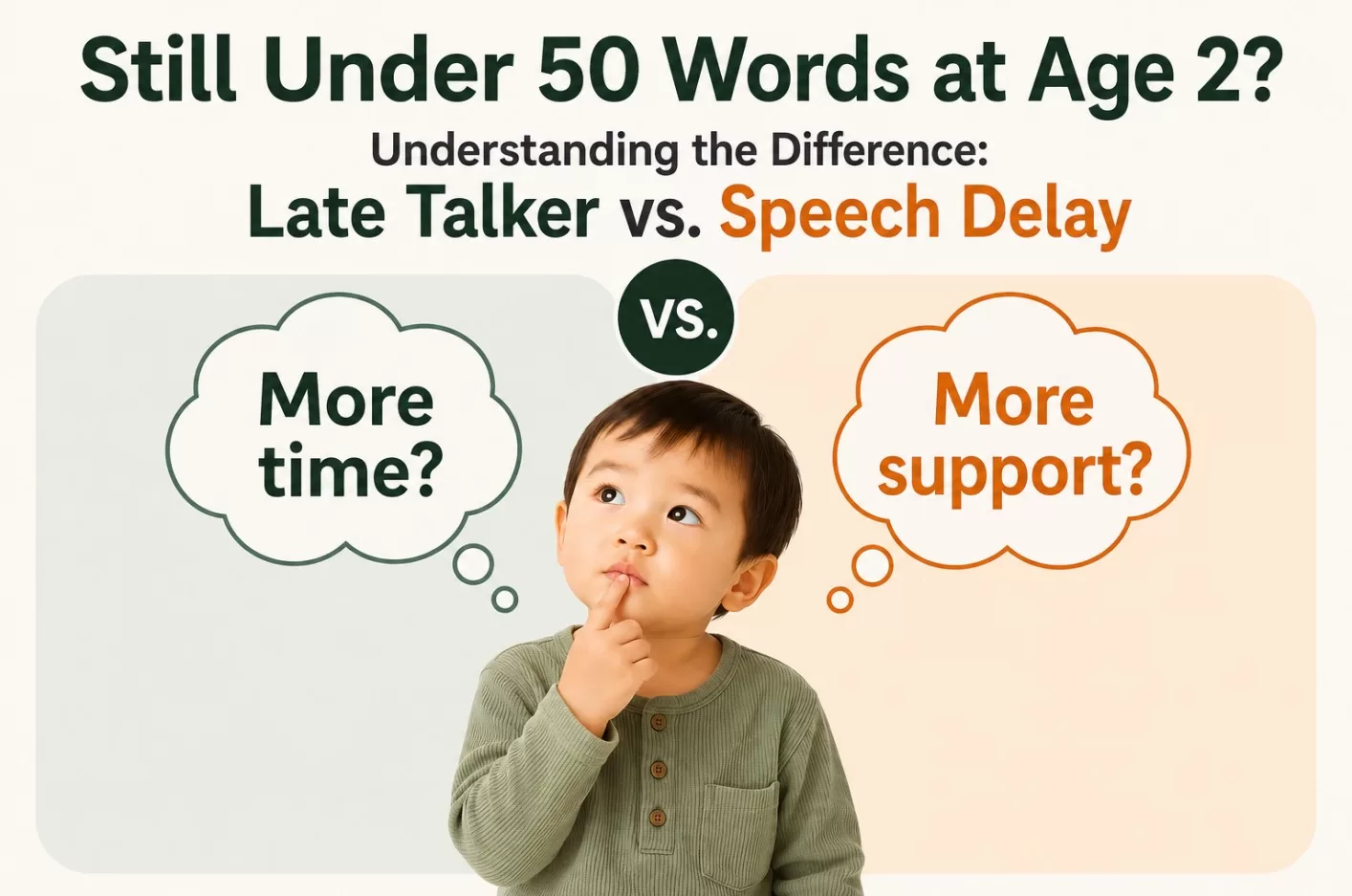
The term late talker is commonly used to describe a young child whose spoken language is developing more slowly than expected.
Professionals may use the term late language emergence for children between approximately 2 and 4 years old whose language development is below age expectations without another diagnosed developmental condition. Some children mainly have difficulty expressing themselves, while others may also have difficulty understanding language.
A child with a broader speech or language delay may also show challenges in areas such as:
- Understanding instructions
- Using gestures
- Playing and interacting with others
- Sharing attention or interests
- Learning new skills
- Maintaining attention
- Developing motor or self-help skills
Communication delays can occur on their own. They may also be associated with hearing differences, developmental language disorder, autism, intellectual disability or other developmental conditions.
Being a late talker does not automatically mean that a child has autism or another diagnosis. The purpose of an assessment is to understand why communication is difficult and what support may help—not simply to apply a label.
Language Milestones at Two Years
Every child develops differently, and milestones should be treated as useful guides rather than pass-or-fail tests.
Between 19 and 24 months, common communication milestones include:
- Using and understanding approximately 50 words
- Combining two or more words, such as “more milk” or “Mummy come”
- Using words to ask for help
- Understanding familiar words and simple instructions
- Pointing to named pictures or body parts
- Using gestures as well as words to communicate
ASHA lists using and understanding at least 50 words and combining two or more words among the communication milestones for children aged 19 to 24 months. The CDC’s two-year milestone checklist also includes putting at least two words together.
Consider seeking professional advice if your two-year-old:
- Uses noticeably fewer words than expected
- Is not yet combining words independently
- Has difficulty understanding simple instructions
- Rarely uses gestures, sounds or words to communicate
- Does not appear interested in communicating with others
- Becomes highly frustrated when trying to express needs
- Is no longer using words or skills they previously had
Missing one milestone does not necessarily mean that a child has a developmental condition. However, if your child is missing several milestones, has stopped making progress or has lost previously acquired skills, it is important to speak with a qualified professional.
Why “Wait and See” May Be Risky
Communication involves much more than saying words.
Children use communication to:
- Ask for what they need
- Refuse or protest appropriately
- Share interests and experiences
- Understand routines and instructions
- Play with family members and other children
- Manage frustration
- Learn new concepts
- Participate in preschool and community activities
When children cannot communicate effectively, they may cry, scream, hit, pull adults towards objects or avoid activities because they do not yet have an easier way to express themselves.
Over time, an untreated communication delay may affect participation in play, social interaction, classroom learning and early literacy. This does not mean that every late-talking child will experience these difficulties. It means that an assessment can help parents understand the level of risk instead of relying on guesswork.
The CDC advises parents to act early when they are concerned because early intervention can help children develop new abilities and is generally more effective when provided earlier rather than later.
Why the Early Years Matter
The early years are an important period for speech and language development. Young children learn through repeated interactions, play, daily routines and carefully structured teaching.
During this period, children are rapidly developing:
- Communication
- Attention
- Play skills
- Social interaction
- Emotional regulation
- Problem-solving
- Learning readiness
- Independence
Early intervention uses everyday activities and planned learning opportunities to strengthen these foundational skills.
This does not mean that older children cannot make meaningful progress. Children and teenagers can continue learning at any age. Starting earlier simply gives a child more time and more opportunities to practise important skills before developmental gaps become wider.
Common Myths About Speech Delay
Myth 1: “The Parents Caused the Delay”
Speech and language delays are not caused by parents being busy, working outside the home or failing to love their child enough.
Communication development is affected by many biological, developmental and environmental factors. Parents should not be blamed.
What parents can do is respond proactively by discussing concerns with qualified professionals and creating more opportunities for meaningful communication at home.
Myth 2: “Boys Always Talk Later”
There can be differences in the timing of early language development, but a child’s gender should not be used as a reason to ignore missed milestones.
A boy who is not meeting communication milestones deserves the same careful assessment and support as any other child.
Myth 3: “Learning Several Languages Caused the Delay”
Growing up with Cantonese, English, Mandarin or another combination of languages does not cause a speech or language disorder.
A multilingual child’s total communication skills should be considered across all the languages they use. Assessments should also take the child’s language background into account rather than comparing them only with monolingual children.
Parents should continue speaking the languages they know best and use most naturally with their child.
Myth 4: “My Child Will Definitely Outgrow It”
Some late talkers catch up without intensive support. Others continue to have difficulties with language, literacy, learning or social communication.
Unfortunately, parents and professionals cannot always identify future “late bloomers” simply by observing a child at one point in time.
An assessment can provide reassurance when development is progressing well. When support is needed, it allows intervention to begin earlier.
Myth 5: “We Can Wait Until School Starts”
Children do not need to wait until kindergarten to receive help.
Communication, play, attention and learning-readiness skills begin developing long before formal schooling. Addressing difficulties during the toddler or preschool years may help a child participate more successfully when they enter a classroom.
What Parents Can Do at Home
Parents are important communication partners. Small changes during everyday activities can create many opportunities for learning.
Follow Your Child’s Interests
Join activities your child already enjoys. Children are more likely to communicate when they are interested and motivated.
Use Short, Clear Language
Describe what your child is doing using words and phrases that are easy to understand:
- “Car goes.”
- “Open box.”
- “More bubbles.”
- “Daddy is cooking.”
Pause and Wait
After offering a toy, snack or activity, pause briefly. Give your child time to look, gesture, make a sound, use a picture or attempt a word.
Avoid immediately guessing and giving everything before your child has an opportunity to communicate.
Expand What Your Child Says
When your child says one word, respond with a slightly longer phrase.
For example:
- Child: “Ball.”
- Adult: “Red ball.”
Or:
- Child: “Juice.”
- Adult: “More juice.”
Celebrate Every Meaningful Attempt
Communication does not have to begin with perfectly spoken words. Acknowledge meaningful attempts involving:
- Eye gaze
- Gestures
- Pointing
- Sounds
- Words
- Signs
- Pictures
- Communication devices
Home strategies are valuable, but they should not replace professional assessment when developmental concerns are present.
When Should Parents Seek Professional Help?
Instead of asking, “Should we wait?”, consider asking:
“Would an assessment help us understand our child better?”
Speak with a professional when:
- You are concerned about your child’s communication
- Your child is missing several age-related milestones
- Your child is not progressing or gaining new words
- Your child frequently appears not to hear or understand you
- Communication difficulties are contributing to frustration or challenging behaviour
- Your child has lost words, gestures, play or social skills
- Teachers or caregivers have also expressed concerns
Depending on your child’s needs, you may consult:
- A paediatrician or developmental paediatrician
- A speech-language therapist
- An audiologist for a hearing assessment
- A clinical psychologist or child psychiatrist
- An occupational therapist
- A behaviour therapist
- Other developmental specialists
Hearing should be considered as part of the evaluation because undetected hearing difficulties can affect speech and language development.
An assessment does not automatically result in a diagnosis. It may include a parent interview, developmental history, observation, hearing checks and direct assessment of communication, play, learning and social interaction.
The outcome should give parents clearer information about:
- Their child’s current strengths
- Skills that may require support
- Possible reasons for the delay
- Appropriate treatment or educational options
- Strategies that can be used at home
Choosing Evidence-Based Intervention
Seeking help early is important, but choosing appropriate, evidence-based support is equally important.
There is no single programme that is suitable for every child. Depending on the child’s profile, intervention may involve speech-language therapy, parent coaching, occupational therapy, developmental teaching, behavioural intervention or a combination of approaches.
For children with autism or broader developmental needs, Applied Behaviour Analysis, or ABA, is one behavioural approach used to teach communication, learning, play, daily living and other functional skills. Progress should be measured, and teaching should be adjusted according to the child’s response.
Verbal Behaviour, or VB, is an ABA-based approach that focuses on why and how a child communicates. Instead of teaching children only to repeat or memorise words, it teaches language for meaningful purposes, such as:
- Requesting something they want
- Asking for help
- Naming objects and actions
- Answering questions
- Following different types of instructions
- Participating in conversations
An ethical ABA-VB programme should be:
- Individualised to the child
- Respectful and motivating
- Focused on functional, meaningful skills
- Based on assessment and ongoing data
- Responsive to the child’s progress
- Collaborative with parents and other professionals
ABA-VB should not be treated as a one-size-fits-all speech programme. When appropriate, behaviour therapists should collaborate with speech-language therapists, teachers, occupational therapists and healthcare professionals.
What Could Happen When Support Is Delayed?
No professional can predict a child’s future with certainty. Children who begin intervention later can still make significant progress.
However, delaying assessment may mean losing valuable learning opportunities during an important stage of development.
Depending on the child, continued communication difficulties may contribute to:
- Slower development of functional language
- Increasing frustration when needs cannot be expressed
- Difficulty following routines and instructions
- Reduced participation in play and social activities
- Challenges with preschool learning readiness
- Greater support needs later
- Developmental gaps that require more time to address
Early intervention cannot guarantee a particular outcome. What it can offer is more time, more practice and more opportunities for a child to build useful lifelong skills.
Do Not Ignore Your Concerns
Parents know their children well. When something does not feel right, seeking advice is not an overreaction—it is a responsible step towards understanding your child.
You do not need to wait for your child to fall further behind. You also do not need to wait for a formal diagnosis before asking how to support a specific communication difficulty. The CDC notes that treatment for concerns such as language delay often does not need to wait until an autism assessment has been completed.
An early assessment may confirm that your child is progressing appropriately and provide reassurance. It may also identify an area in which early support could make learning easier.
Either way, having reliable information allows you to make informed decisions.
When it comes to a toddler who is not talking as expected, it is usually better to ask early than to wonder later whether waiting delayed the help they needed.
This article provides general educational information and is not a substitute for individual medical, developmental or speech-language advice. Parents who have concerns about their child’s development should consult qualified healthcare and developmental professionals.
