Learning that your child may need a developmental assessment can bring many questions and emotions.
“Where do we go?”
“How long will we need to wait?”
“Should we start therapy before we receive a diagnosis?”
These are common concerns shared by many families in Hong Kong.
Every year, more children are referred for assessment related to autism spectrum disorder (ASD), developmental delay, speech and language difficulties, ADHD, learning challenges and other developmental concerns. As awareness grows, more families are seeking support earlier and this is an important step forward.
Hong Kong’s assessment and support system has also continued to evolve. Today, families have clearer pathways for referral, better coordination between healthcare, education, social services and greater awareness of the importance of early support.
You Don’t Have To Wait: Early Intervention Can Make A Difference Even Before A Diagnosis
However, families may still face challenges, particularly when accessing public assessment services. Waiting times can be long, and many parents understandably worry that valuable time for intervention may be lost.
The most important message for families is:
Waiting for an assessment does not mean waiting to support your child.
Understanding the Autism and Developmental Assessment Pathway
Many parents hear the terms screening, assessment and diagnosis used together, but they represent different stages of the journey.
1. Screening: Identifying Possible Concerns
Screening is an early check to determine whether a child may be showing signs of developmental differences.
It may involve:
- developmental questionnaires
- parent observations
- teacher feedback
- healthcare professional observations
Screening helps identify children who may need further evaluation, but it does not provide a diagnosis.
2. Comprehensive Assessment: Understanding the Child
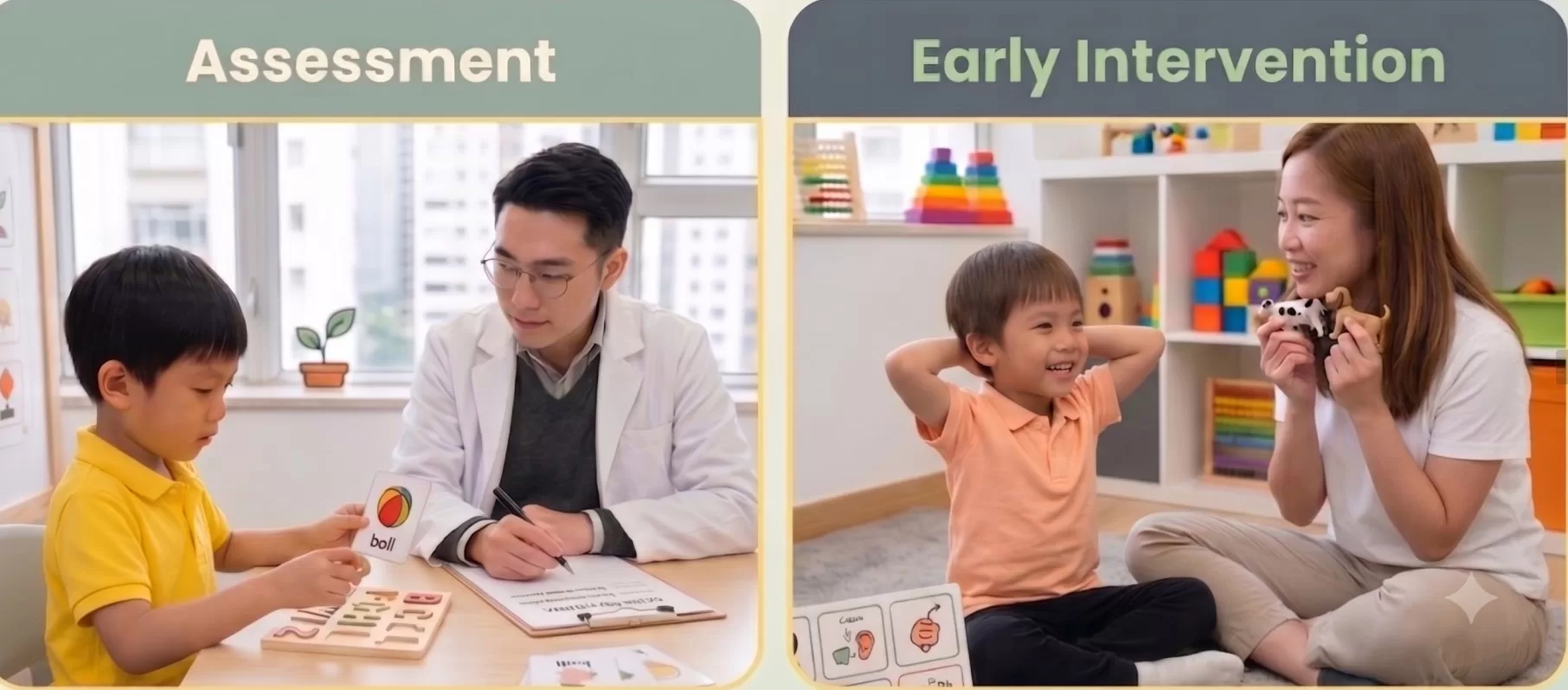
A developmental assessment looks at different areas of a child’s development, including:
- communication and language
- social interaction
- play skills
- learning and cognitive development
- behaviour
- sensory processing
- motor skills
- daily living abilities
Depending on the child’s needs, different professionals may be involved, including developmental paediatricians, clinical psychologists, speech therapists, occupational therapists and behavioral therapists.
A comprehensive assessment provides a clearer understanding of the child’s developmental profile and helps guide recommendations for support.
3. Diagnosis: A Guide for Support Planning
A diagnosis is made by appropriately qualified professionals like developmental paediatricians based on clinical assessment.
For many families, receiving a diagnosis provides clarity and helps them understand their child’s needs. It may also support access to educational planning, intervention services and community resources.
However, a diagnosis is not the starting point of helping a child develop.
Support can begin based on a child’s individual needs and developmental challenges, even while the assessment process is still ongoing.
How Hong Kong’s Assessment Pathway Has Evolved
Over the years, Hong Kong has made important improvements in identifying and supporting children with developmental needs.
Previously, many families struggled with uncertainty about where to seek help or which service to approach first. Today, the pathway is more structured, with greater collaboration between government departments and professionals.
The Comprehensive Child Development Service (CCDS) was established through collaboration between the Education Bureau, Department of Health, Hospital Authority, and Social Welfare Department. Its goal is to strengthen early identification and referral of children with developmental concerns.
Families may enter the pathway through different points, including:
- Maternal and Child Health Centres
- schools and kindergartens
- family doctors
- healthcare professionals
Children who require further evaluation may then be referred to appropriate assessment services.
This coordinated approach represents meaningful progress. Families today have clearer guidance, improved communication between services and greater recognition that early identification and support are essential.
The Reality: Public Waiting Lists and Access Challenges
While the system has improved, one of the biggest challenges families continue to experience is access to timely assessment.
As awareness of developmental conditions increases, more families are seeking evaluations. Public services must manage a growing number of referrals while prioritising children based on clinical needs.
For parents, waiting can feel extremely difficult.
Many ask:
“Is my child falling behind while we wait?”
“Should we do something now or wait until we receive a diagnosis?”
These concerns are understandable.
A long waiting period can create stress and uncertainty for families. It may also delay access to certain supports, particularly services that require formal assessment documentation and therapy.
However, it is important for parents to know that developmental support or therapy does NOT have to begin only after a diagnosis is confirmed.
Early action can make a meaningful difference.
You Don’t Have to Wait for a Diagnosis to Start Therapy
One of the most common misconceptions among parents is that a child must receive a formal diagnosis before beginning therapy.
In reality, many children can benefit from evidence-based intervention while they are waiting for assessment and diagnosis.
If a child is experiencing challenges with communication, social interaction, learning, behaviour, play skills or daily living abilities, support can often begin based on the child’s current needs.
Early intervention provides children with opportunities to build important developmental skills during a critical period of learning and growth. Starting support early does not mean assuming a diagnosis, it means responding to the child’s needs as early as possible.
The goal is not to wait for a label. The goal is to help the child develop the skills they need to communicate, participate, learn, and thrive.
Choosing Evidence-Based Intervention
When seeking therapy, parents should look for programmes that are:
- based on scientific evidence
- delivered by appropriately trained and experienced professionals
- individualized to the child’s developmental profile
- focused on meaningful skills that improve everyday life
For children with autism or significant social communication challenges, families should look for evidence-based approaches such as Applied Behavior Analysis (ABA), including Verbal Behavior (ABA-VB) approaches.
ABA-VB focuses on developing functional communication and meaningful skills by understanding how children learn and using structured teaching strategies. Goals may include:
- requesting needs and wants
- improving communication
- developing play skills
- increasing independence
- strengthening social interaction
- learning everyday routines
However, autism and developmental differences present differently in every child. There is no single approach that works for every child. Some children may benefit from a combination of supports, including speech and language therapy, occupational therapy, physiotherapy and educational support.
The most important factor is that intervention is appropriate for the child’s individual needs and delivered using approaches supported by evidence.
What Parents Can Do While Waiting
Waiting for an assessment can feel like a period where families have limited options. However, there are many meaningful steps parents can take during this time.
1. Observe and Understand Your Child
Parents know their children best.
Take time to notice:
- what motivates your child
- how they communicate
- activities they enjoy
- situations they find challenging
- sensory preferences
- strategies that help them feel comfortable and regulated
These observations are valuable information for future assessments and help therapists create more personalized intervention plans.
2. Work Together with Teachers
Teachers and early childhood educators often provide important observations because they see children in social and learning environments. Sharing information between home, school and therapy providers helps create consistency and allows everyone to work toward common goals.
3. Build Skills Through Everyday Activities
Therapy does not only happen during scheduled sessions.
Children learn through everyday experiences, including:
- talking and reading together
- encouraging communication during meals and routines
- playing turn-taking games
- practising independence skills
- following predictable daily routines
Small moments repeated consistently can create meaningful progress.
Public and Private Assessment Pathways
Families in Hong Kong may consider different pathways depending on their circumstances.
1. Public Pathway
The public system provides access to government-supported assessment and services. It remains an important pathway for many families, particularly because it connects children with broader healthcare and educational support.
However, families should be prepared for possible waiting periods due to high demand.
2. Private Pathway
Some families choose private assessment or therapy services while waiting for public appointments.
Private services may provide earlier access, but families should carefully consider:
- the qualifications of professionals
- the evidence behind the intervention approach
- whether recommendations are individualized
- how reports may support future educational planning
There is no single correct pathway. Each family makes decisions based on their child’s needs, available resources and circumstances.
After Assessment: The Journey Continues
An assessment is an important milestone, but it is not the end of the journey.
The purpose of assessment is to better understand the child and identify appropriate supports.
Depending on the child’s needs, recommendations may include:
- speech and language intervention
- occupational therapy
- behavioural therapy (ABA-VB)
- special education services
- school-based accommodations
The focus should always remain on helping children develop their abilities, participate meaningfully and reach their potential.
A Message of Encouragement for Parents
Beginning the assessment journey can feel overwhelming. Waiting for answers can be stressful, especially when parents simply want to help their child as soon as possible. It is important to recognise both realities:
Hong Kong’s developmental assessment pathway has made significant progress. Families today have clearer routes to assessment, stronger collaboration between services and greater awareness of early intervention. At the same time, waiting times and access challenges remain real concerns for many families.
The most empowering step parents can take is to stay informed and take action where possible. You do not need to wait for a diagnosis to begin supporting your child and begin therapy. Every interaction, every opportunity to communicate, every new skill practised and every moment of connection contributes to your child’s development.
Early support begins with understanding your child and helping them take the next step forward.
