You may have seen this claim online:
“93% of communication is non-verbal.”
It appears frequently in parenting posts, communication training, early-intervention content, and social media graphics. Because the number is so specific, it sounds scientific.
But is 93% of everything we communicate really nonverbal?
Not exactly.
The research behind this famous statistic is real—but it has often been applied far beyond what the original studies actually examined.
Where Did the 93% Statistic Come From?
The famous figure comes from research conducted by psychologist Albert Mehrabian and his colleagues in 1967.
Two studies are usually associated with what later became known as the 7-38-55 rule.
The first, Decoding of Inconsistent Communications, by Albert Mehrabian and Morton Wiener, examined what happened when the emotional meaning of a spoken word did not match the speaker’s tone of voice.
The second, Inference of Attitudes from Nonverbal Communication in Two Channels, by Mehrabian and Susan Ferris, examined how people interpreted attitudes from facial expressions and vocal tone.
These findings were later summarised as:
- 7% — words
- 38% — vocal tone
- 55% — facial expression
Combine 38% and 55%, and you get the familiar 93%.
However, there is an important limitation.
The Studies Were Not About All Communication
Mehrabian’s studies did not show that words account for only 7% of everything people communicate.
The experiments focused on very specific situations involving the communication of feelings and attitudes, particularly when different parts of the message did not match.
For example, imagine someone saying:
“I’m fine.”
Their words sound positive, but their tone is angry and their facial expression suggests frustration.
In a situation like this, people may rely more heavily on tone and facial expression when deciding how the person actually feels.
That is very different from saying that words account for only 7% of everyday communication.
After all, try explaining a school timetable, giving directions, reading a story, or teaching a new concept using facial expressions alone. The words clearly matter.
Mehrabian himself later emphasised that his findings should not be applied to communication in general.
So Why Is the “93%” Claim So Popular?
Because it is memorable.
“93% of communication is nonverbal” is much easier to remember and share than:
“Nonverbal cues may strongly influence how people interpret feelings when verbal and nonverbal messages are inconsistent.”
Unfortunately, simplifying research into one catchy number can also change its meaning.
That does not mean nonverbal communication is unimportant.
Quite the opposite.
It simply means that we do not need an inaccurate percentage to explain why it matters.
Nonverbal Communication Still Matters for Children
Young children communicate long before they can speak in full sentences.
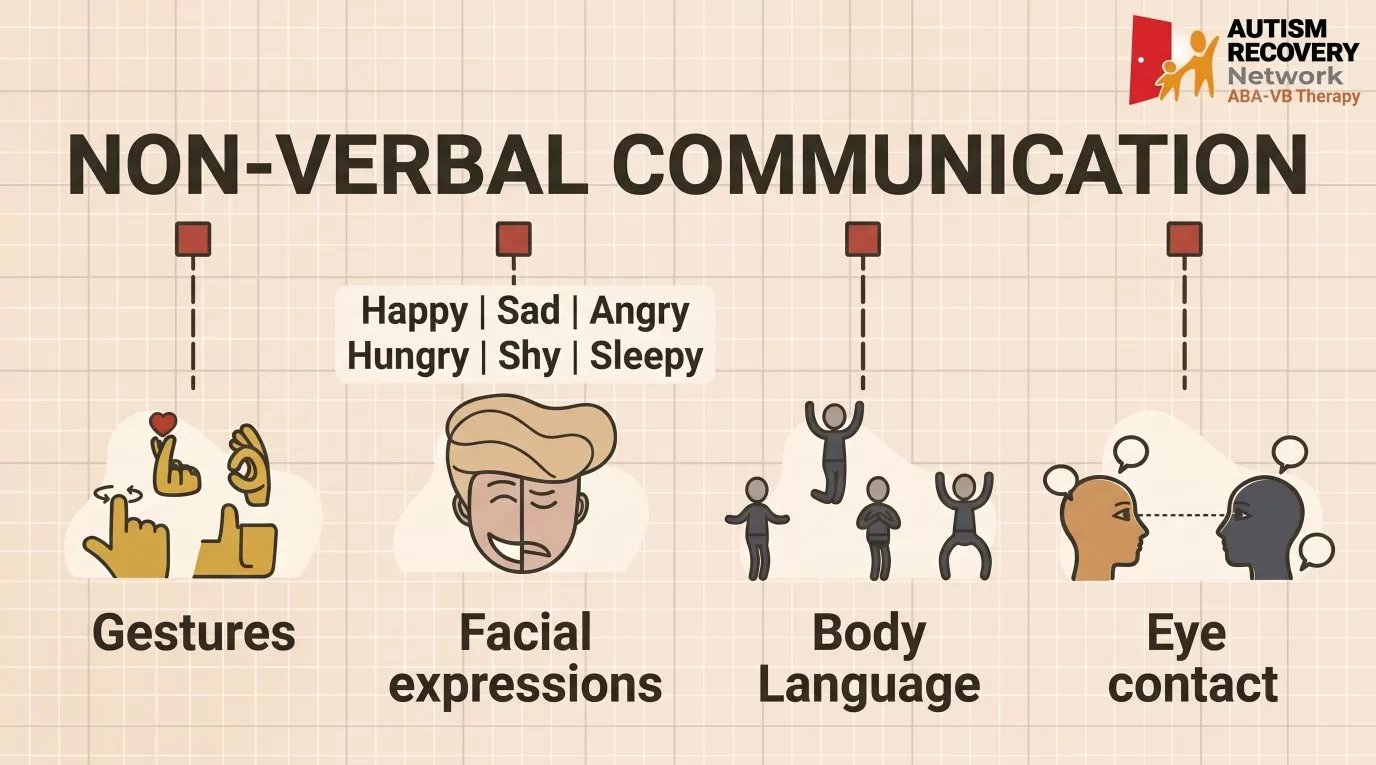
Communication can include:
- Pointing
- Gestures
- Facial expressions
- Vocal sounds
- Showing or giving objects
- Taking turns
- Responding to another person’s actions
- Sharing attention around an object or activity
These early communication behaviours can provide important opportunities for interaction and learning.
One particularly important skill is joint attention—when a child and another person share attention around the same object, activity, or event.
For example, a child might notice bubbles, point towards them, and then look or orient towards a parent to share the experience.
Research has found meaningful relationships between joint attention and language development, including in autistic children.
So nonverbal and verbal communication should not be viewed as competitors.
They often develop and work together.
What Does This Mean for Children With Autism?
For autistic children and children with developmental delays, communication may look different from child to child.
Some children use spoken language frequently. Others may communicate through gestures, pictures, signs, sounds, or augmentative and alternative communication (AAC).
Social communication may also involve skills such as:
- Requesting
- Sharing interests
- Taking turns
- Responding to communication from others
- Using gestures
- Understanding language
- Expressing wants, needs, and ideas
The goal should not be to decide whether verbal or nonverbal communication is more important.
Instead, parents and professionals can ask:
“How is this child communicating now, and how can we help them communicate more effectively?”
For one child, that may involve expanding spoken language. For another, it may involve teaching clearer gestures, requesting skills, AAC, joint attention, or a combination of communication approaches.
A Better Way to Read Statistics Online
The story behind the 93% statistic offers another useful lesson for parents.
When you see an impressive statistic online, ask:
Where did this number come from?
Then consider:
- What did the original research actually study?
- Who participated in the research?
- What situation was being tested?
- Does the conclusion match what the social media post is claiming?
- Has later research supported the same interpretation?
A statistic may be technically connected to a real study while still being used in a misleading way.
Checking the original source can make a big difference.
The Takeaway: Look Beyond the Number
So, is 93% of communication nonverbal?
No—not in the way this statement is usually presented.
The 7-38-55 rule came from specific experiments about interpreting feelings and attitudes when verbal and nonverbal cues did not match. It was never intended to describe all human communication.
However, the broader idea is still useful:
Communication is more than words.
For children, gestures, shared attention, facial expressions, sounds, language, and other forms of communication can all play meaningful roles.
Rather than focusing on a percentage, focus on the child in front of you.
Observe how they communicate, what they understand, and which skills could help them participate more successfully in everyday life.
Sometimes, looking beyond a catchy statistic gives us something much more valuable: a clearer understanding of what the research actually means.
How ABA-VB Supports Meaningful Communication
At ARN, our ABA-VB programmes focus on helping children develop functional communication skills that are useful in everyday life. This may include learning to request, respond to questions, follow instructions, label objects and actions, take turns, and communicate needs more independently.
Importantly, communication is not limited to spoken words. Depending on the child, therapists may also work on gestures, joint attention, social interaction, and other communication skills while gradually building language.
Rather than relying on a general statistic such as “93% of communication is nonverbal,” an individualised ABA programme looks at how each child communicates now, which skills are missing, and what can be taught next. Progress can then be monitored and goals adjusted based on the child’s development.
Not Sure How Your Child Is Communicating?
If you are concerned about your child’s communication, language, or social interaction, Autism Recovery Network offers a FREE 30-minute parent consultation. Our team can help you better understand your child’s current communication skills and discuss how an individualised ABA-VB programme may support their development.
