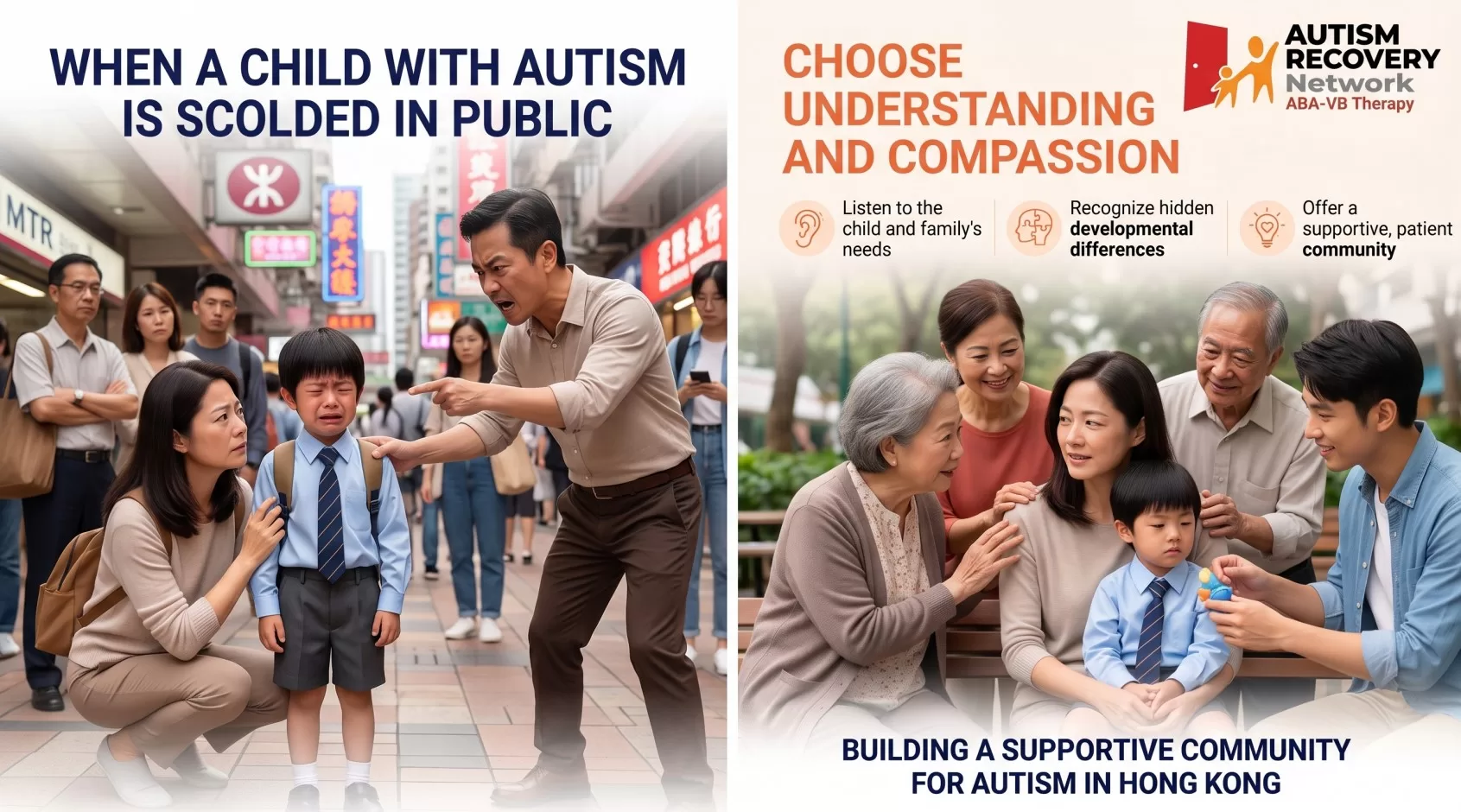
A child starts crying loudly in a shopping centre. Another covers their ears on the MTR. A child drops to the floor when it is time to leave a shop.
People may stare. Someone may comment:
“Control your child.”
Or worse, a stranger may directly scold them.
To someone who does not know the child, the behaviour may look like poor discipline. However, for an autistic child or a child with developmental differences, there may be much more happening beneath the surface.
Sometimes, what looks like “bad behaviour” may be a child struggling with sensory input, communication, unexpected change or an overwhelming situation.
What Might Be Happening Beneath the Behaviour?
Autism affects people differently. The CDC explains that autistic people may experience differences in communication, behaviour, responses to change and sensory input.
Consider these everyday situations.
At a Shopping Centre
A child suddenly covers their ears and cries.
The environment may be crowded, bright and noisy. Music, announcements, people talking and unexpected sounds may all be happening at once.
The child may be experiencing sensory overload, rather than deliberately causing a scene.
When It Is Time to Leave
A child drops to the floor when a parent says it is time to leave a favourite shop.
The difficulty may be the sudden transition from a preferred activity to something less predictable.
Autistic people can experience difficulty with changes in routine and transitions, although the degree varies greatly from person to person. NIMH provides an overview of these different autism characteristics and support needs.
At a Restaurant
Another child may repeatedly make sounds, move around or become distressed when their usual meal is unavailable.
Perhaps waiting is difficult. Maybe the restaurant is too noisy, the food looks different from what was expected, or the child cannot easily communicate what is wrong.
Behaviour tells us that something is happening. Understanding the reason is often more useful than immediately judging the behaviour itself.
What Happens When a Stranger Scolds the Child?
Imagine already feeling overwhelmed—and then an unfamiliar adult suddenly raises their voice at you.
For some children, this may add even more stress.
They may become frightened, cry more intensely, try to escape or struggle to understand what the person expects them to do differently.
Meanwhile, the parent may already be trying to:
- Keep the child safe
- Identify what triggered the situation
- Reduce sensory demands
- Help the child communicate
- Guide them towards a calmer response
Criticism from strangers can add another layer of pressure to an already difficult moment.
This does not mean unsafe behaviour should simply be ignored. Safety comes first. However, safety can often be addressed calmly without shaming or frightening the child.
What Can People Around the Family Do?
You do not need to know a child’s diagnosis to respond with patience.
If a child is crying, shouting or struggling in public:
- Give the family some space.
- Avoid staring or making negative comments.
- Do not directly scold the child unless immediate safety requires intervention.
- If someone is at risk, offer calm and respectful help.
- Allow the caregiver to manage the situation whenever possible.
Sometimes the most helpful response is simply not adding more pressure.
Autistic children and their families have the same need to access shops, restaurants, transport and community spaces as everyone else.
Helping Children Build Skills for Public Places
Understanding behaviour does not mean expecting the community to accommodate every unsafe or disruptive situation indefinitely.
Children can also be taught skills that help them participate more successfully in everyday environments.
Depending on the individual child, useful goals may include:
- Asking for help
- Requesting a break
- Waiting
- Following simple instructions
- Transitioning between activities
- Communicating discomfort
- Coping with small changes
- Developing greater independence in community routines
The CDC describes Applied Behaviour Analysis (ABA) as a behavioural approach that uses teaching and progress monitoring to develop useful skills. Intervention should always be individualised to the child’s needs rather than assuming that every challenging behaviour has the same cause.
For example, a child who screams because they cannot ask for a break may benefit from learning a clearer communication response. Another child whose distress is related to sensory overload may need environmental adjustments alongside skill-building.
The goal is not to make a child appear “normal” for the comfort of strangers.
The goal is to help them communicate, cope, stay safe and participate more independently in everyday life.
We See a Moment—The Family Lives the Whole Story
When we see a child struggling in public, we usually see only a few minutes of their day.
We may not know how hard they have worked to tolerate that environment, what communication skills they are still learning or what the family has already tried.
A little patience can make a significant difference.
Children with autism and developmental differences are part of our community. They deserve dignity, understanding and opportunities to learn how to participate in everyday life—not public embarrassment for skills they are still developing.
Before judging the behaviour, ask yourself: “Could there be something happening here that I cannot see?”
That small change in perspective can make public spaces feel safer for both children and their families.
Concerned About Your Child’s Behaviour in Public?
If your child struggles with transitions, waiting, communication, sensory situations or challenging behaviour in public, Autism Recovery Network offers a FREE 30-minute parent consultation with an ARN Supervisor.
Parents can discuss situations they are experiencing at home or in the community, better understand possible reasons behind their child’s behaviour and explore whether an individualised ABA-VB programme may help build communication, coping and everyday independence skills.
