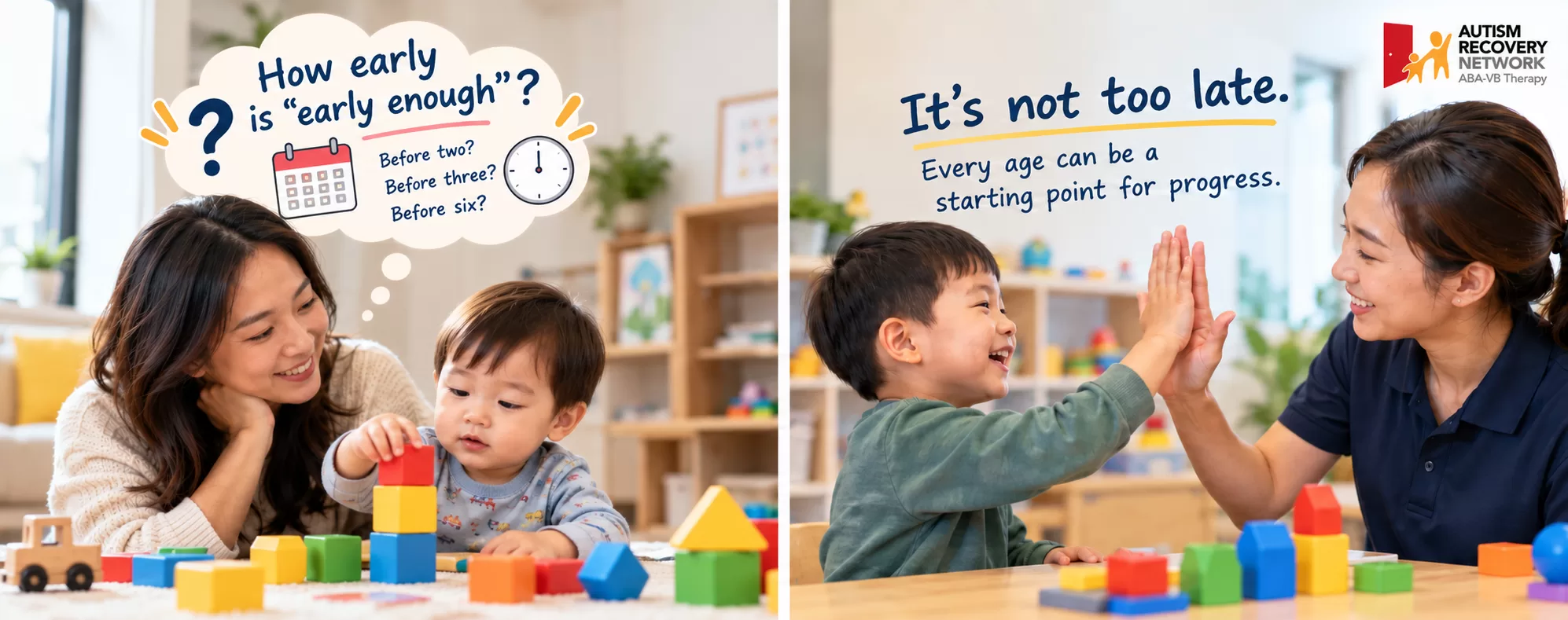
Parents often hear the same advice:
“Start intervention early.”
But what does early actually mean?
Before age two? Before three? Before kindergarten? Before six?
For Hong Kong parents concerned about autism or developmental delays, different age recommendations can make it feel as though there is a deadline they must not miss.
The reality is more reassuring: there is no single birthday when a child’s ability to learn suddenly stops.
Why Does “Early Intervention” Have Different Age Limits?
One reason for the confusion is that “early intervention” does not have one universal age cut-off.
For example, Hong Kong’s Social Welfare Department says its Early Education and Training Centre (EETC) service is designed mainly for children with disabilities from birth to age two. However, eligible children aged two to under six who have not started primary school may also receive the service.
Meanwhile, On-site Pre-school Rehabilitation Services (OPRS) support eligible children under six attending participating kindergartens or kindergarten-cum-child-care centres.
So does early intervention mean before two or before six?
Both descriptions can be correct because they refer to different services and eligibility rules.
A programme’s age limit tells parents who can use that particular service. It is not a biological deadline for learning.
What Does Research Mean by “Early”?
Research uses the term differently too.
Some studies examine intervention beginning before age two, while others include preschool children.
For example, one meta-analysis examining social-communication interventions included 1,442 autistic children with an average age of 3.55 years and found an overall positive intervention effect.
Another review specifically examined interventions beginning before 24 months. It found that results varied across developmental outcomes and concluded that very early intervention did not automatically produce large improvements in every area.
This is important because parents sometimes hear:
“The younger you start, the better the outcome will definitely be.”
Research is more complicated than that.
A review of 14 autism intervention studies examining whether starting younger predicted better outcomes found mixed evidence for a simple “earlier is always better” relationship.
Does That Mean Early Intervention Is Not Important?
No.
The message should not be “age doesn’t matter.”
It should be:
When there is a genuine developmental concern, avoid unnecessary delay in assessment and appropriate support.
Young children are developing communication, play, social interaction, learning and everyday skills rapidly. Starting support when a need is identified can give the child and family more opportunities to practise useful skills.
But “start early” should never become:
“If you didn’t start by age two or three, you have missed your chance.”
Children continue learning beyond the preschool years.
A four-, six- or ten-year-old may still learn meaningful skills in communication, independence, social interaction, emotional regulation and everyday living.
Three Things Matter Alongside Age
Instead of focusing only on when therapy started, parents should also consider what is being taught and how useful it is.
1. Is the Intervention Individualised?
Goals should be based on the child’s current strengths and needs.
One child may need functional communication. Another may need help with imitation, play, self-care, transitions or interacting with other children.
2. Can Skills Be Used Outside Therapy?
Learning should not stop at the therapy table.
If a child learns to say or signal “help,” can they ask Mum for help at home? Can they ask a teacher at school? Can they use the skill when something genuinely goes wrong?
3. Are Parents and Caregivers Involved?
Everyday activities create many opportunities for learning.
Meals, dressing, play, shopping and trips to the playground can all become opportunities to practise communication and independence.
For some autistic children, ABA-based intervention, including ABA-VB teaching strategies, may be used to develop functional communication, learning, play, social and adaptive skills according to individual needs.
The important question is not simply how many therapy hours a child receives, but whether the skills being taught are meaningful, measurable and increasingly useful in everyday life.
What Should Hong Kong Parents Do If They Are Concerned?
You do not need to decide for yourself whether your child is “young enough” for intervention.
If you notice developmental differences, write down what you are seeing and discuss your concerns with an appropriate professional.
Hong Kong’s Department of Health advises parents who are concerned about development to speak with their Maternal and Child Health Centre, family doctor or paediatrician. When appropriate, children may be referred to the Child Assessment Service for further assessment.
Early intervention matters because we do not want to unnecessarily delay opportunities for a child to learn.
But parents do not need to carry the fear that they have already missed a magical window.
Instead of asking:
“Should we have started earlier?”
ask:
“What useful skill can we start teaching today?”
Not Sure Whether Your Child Needs Support?
Autism Recovery Network offers a FREE 30-minute parent consultation with an ARN Supervisor.
Parents can discuss their child’s communication, learning, social interaction and everyday skills, ask questions about developmental concerns, and explore possible next steps, including whether an individualised ABA-VB programme may be appropriate for their child.
