Your child is getting taller, moving up another school year and developing new interests.
But brushing teeth still needs reminders. Getting dressed takes a long time. Packing a school bag still requires help.
Parents sometimes wonder:
“Shouldn’t these things be easier by now?”
For autistic children and children with developmental delays, getting older does not automatically make daily living skills easier. Some skills need to be explicitly taught and practised many times.
A more useful question is:
“Which parts of this task can my child do now, and what should we teach next?”
Why Can Everyday Skills Be Difficult?
An activity that looks simple may involve many different skills.
Getting dressed requires remembering the sequence, orienting clothes correctly, balancing and coordinating both hands. Toothbrushing involves remembering the steps and tolerating different sensations.
Hong Kong’s Child Assessment Service includes self-care, motor skills, communication, attention and learning among the areas considered during developmental assessment.
So when a child struggles, ask which part is difficult rather than assuming they are simply refusing.
Understanding Is Not the Same as Doing
A child may understand:
“Go and get dressed.”
But understanding the instruction does not mean they can organise and complete every step independently.
Motor planning, coordination, attention, communication and sensory differences can all affect daily routines. Teaching the task is often more useful than repeatedly saying, “You know how to do this.”
Break Big Tasks Into Smaller Steps
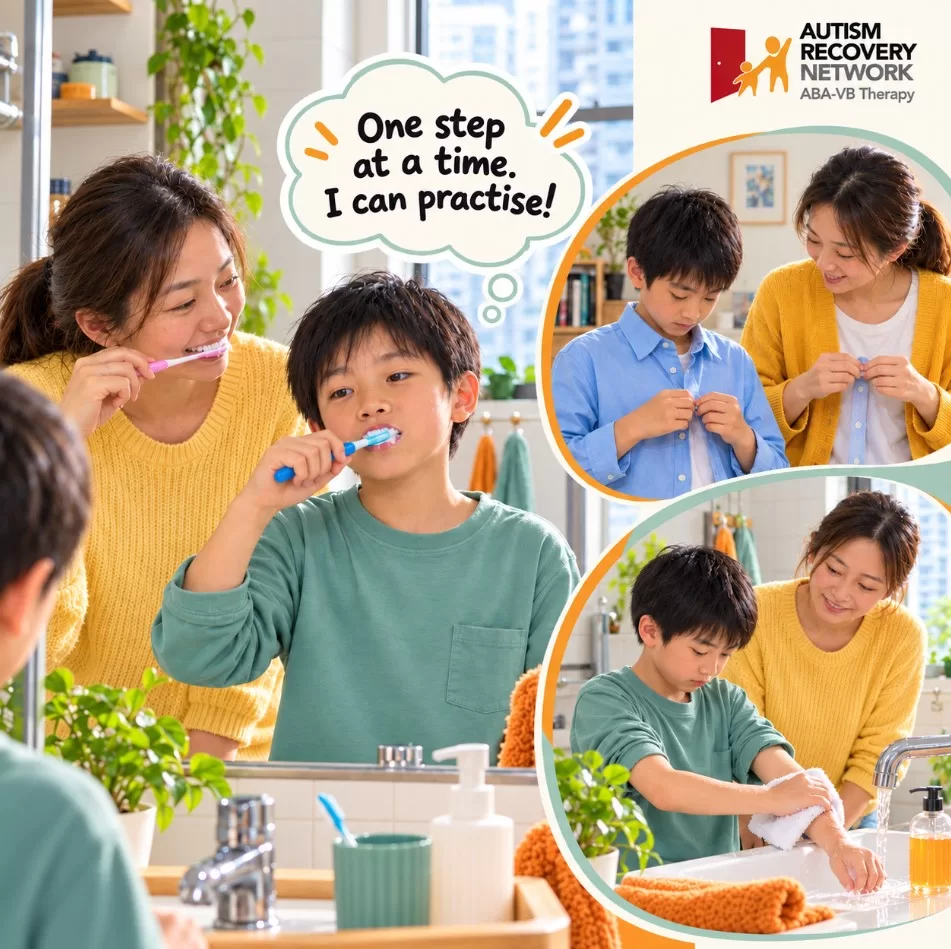
Instead of treating “brush your teeth” as one large task, break it down:
Pick up toothbrush → open toothpaste → add toothpaste → brush → rinse → put everything away.
This is often called task analysis.
A child may complete several steps independently but still need help with one or two. That shows where teaching should focus.
Support might include modelling, pictures, gestures or verbal reminders. As the child improves, prompts should gradually be reduced.
Practise Skills in Everyday Life
Learning self-care only during therapy is not enough. Children need opportunities to use skills during real routines.
Bath time can include washing one body part independently. Getting ready for school can include packing one item. Snack time can involve opening a container.
Choose one or two useful steps, give your child time to try and provide only as much help as needed. As the skill improves, practise with different clothes, caregivers or places.
The goal is for the skill to become useful beyond the teaching session.
What If Motor or Sensory Difficulties Are Involved?
Sometimes practice alone is not enough.
The CDC notes that occupational therapy may support daily living skills such as dressing, eating and bathing, while physical therapy may help with motor skills.
CDC: Autism Treatment and Intervention
For some children, full independence may not be realistic in every task. Progress might mean pulling up a shirt independently, using adapted utensils or communicating when help is needed.
Participation, communication and choice are also meaningful forms of independence.
How Can ABA-VB Support Daily Living Skills?
An individualised ABA-VB programme may help break routines into teachable steps and build independence gradually.
Goals may include dressing, toothbrushing, eating, packing belongings, following routines or completing simple chores.
Functional communication is also important. A child may learn to say, gesture, point to a picture or use AAC to communicate:
“Help.”
“Finished.”
“I need a break.”
The goal is not perfection. It is to help the child do more for themselves, communicate when they need support and participate more meaningfully in daily life.
Growing Older Does Not Mean It Is Too Late
If your child is older and still needs help with everyday routines, it does not mean nothing can change.
Start with skills that would make the biggest difference to daily life. One small step—putting on a shirt, brushing part of their teeth or packing one section of their school bag—can become the foundation for the next.
Need Help Building Everyday Independence?
Autism Recovery Network provides individualised ABA-VB programmes that can support functional communication, self-help skills, flexibility and independence according to each child’s abilities and priorities.
ARN also offers a FREE 30-minute parent consultation with an ARN Supervisor. Parents can discuss difficult everyday tasks, identify practical teaching priorities and explore whether individualised ABA-VB support may help their child build useful skills for home, school and the community.
