You ask your child:
“Do you want a snack?”
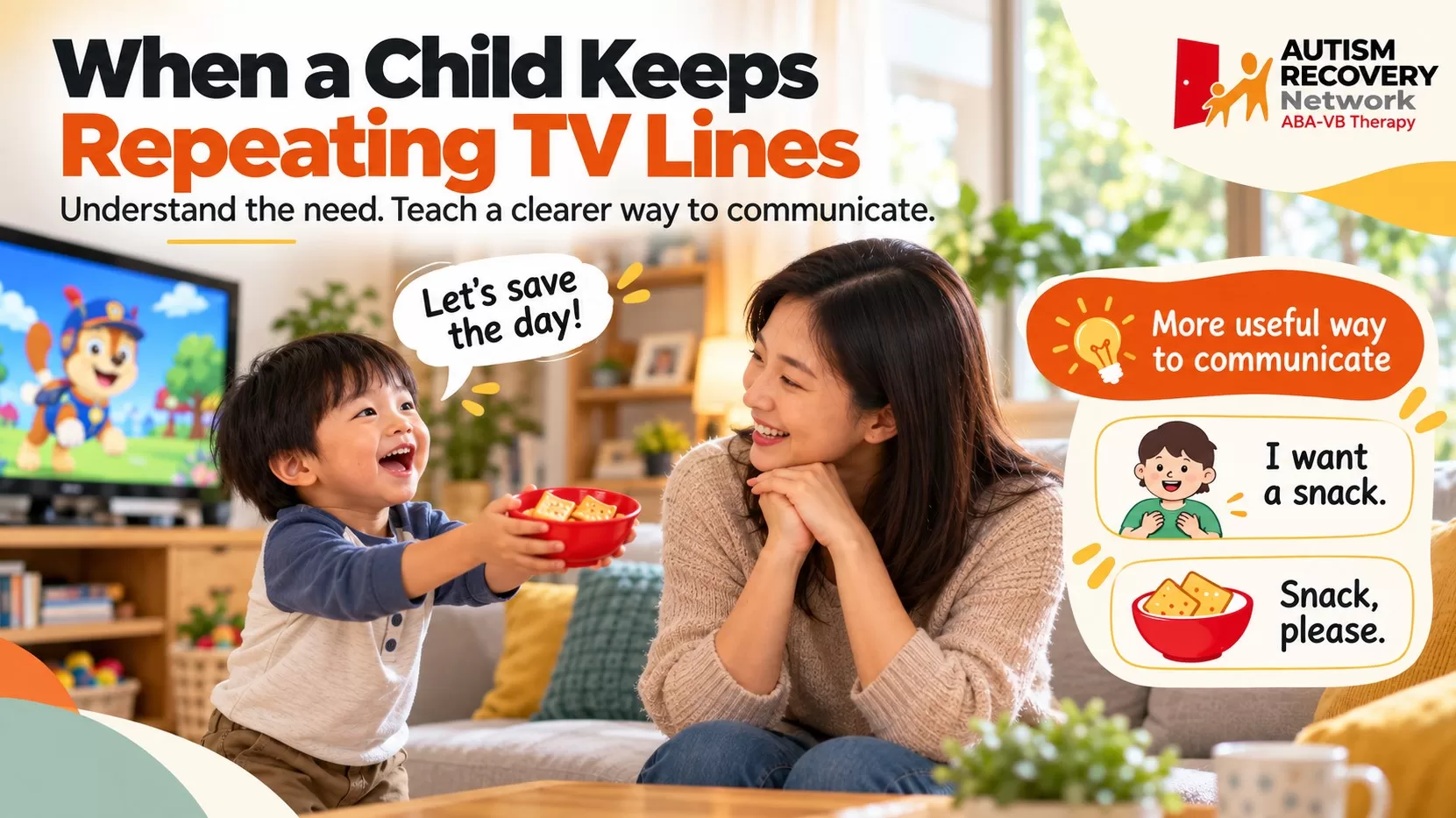
Instead of answering, they suddenly say a line from a favourite cartoon:
“To infinity and beyond!”
Or perhaps the same phrase from a TV programme, advertisement or YouTube video appears again and again throughout the day.
Parents often wonder:
“Why does my child keep repeating TV lines—and should I stop it?”
This repeated language may be echolalia. Understanding why it happens can help parents respond in a more useful way.
What Is Echolalia?
Echolalia means repeating words or phrases previously heard.
It may be immediate, when a child repeats something shortly after hearing it, or delayed, when they repeat language heard hours, days or even much earlier.
For example, a child might repeat your question:
Parent: “Do you want juice?”
Child: “Do you want juice?”
Another child might use a familiar phrase from a television programme whenever they want something.
The US National Institute on Deafness and Other Communication Disorders includes both immediate and delayed echolalia among language patterns that may be seen in autistic children.
Repeating a TV Line May Be Communicating Something
Echolalia should not automatically be treated as meaningless language.
Research and clinical guidance recognise that repeated language can sometimes serve functions such as requesting, protesting, labelling, answering, taking a conversational turn or communicating another message. ASHA
For example:
A child who says “Let’s get out of here!” whenever an activity becomes difficult may be communicating:
“I want to stop.”
A child who quotes a restaurant advertisement when walking towards the kitchen may be trying to say:
“I’m hungry.”
Another child may repeat familiar language when excited, anxious or overwhelmed, or because the phrase itself is enjoyable or regulating.
That does not mean every repeated sentence has a hidden meaning. Instead of guessing, look at the context and pattern.
Ask: What Was Happening When They Said It?
Before trying to stop a repeated phrase, observe what happens around it.
Consider:
- What happened immediately before the phrase?
- Who was present?
- Was the child being asked to do something?
- Were they excited, tired or overwhelmed?
- What happened after they said it?
- Does the same phrase appear in similar situations?
Over time, patterns may become clearer.
For example, if your child repeatedly quotes the same TV line whenever a difficult task is presented—and the phrase is followed by trying to leave—the line may be connected with wanting a break.
The question changes from:
“How do I stop this phrase?”
to:
“What might my child need at this moment?”
Teach Communication That Is Easier to Understand
If you identify a likely message, you can teach a simpler and more flexible way to communicate it.
If:
“Let’s get out of here!”
seems to mean the child wants to stop, teach:
“Break, please.”
If a food commercial appears whenever they are hungry, teach:
“Snack please,” “I want noodles,” or another appropriate request.
The child does not necessarily need spoken words. Functional communication may include:
- Gestures
- Signs
- Pictures
- AAC
- Word approximations
- Spoken language
The aim is not simply to eliminate echolalia. It is to give the child more communication options.
Build More Than Requests
As communication develops, parents and therapists can work on different purposes for language.
A child may learn to:
Request: “Help me.” “I want juice.”
Refuse or protest: “No.” “Stop.” “I need a break.”
Comment: “That’s funny.” “It’s loud.”
Answer: responding meaningfully to simple questions.
Interact: greeting someone, taking conversational turns or inviting another person to play.
ASHA notes that echolalia itself may have communicative functions and recommends considering its function when assessing autistic communication. ASHA
ASHA: Autism and Communication
How Can ABA-VB Help?
Within an individualised ABA-VB programme, therapists can look at what a child is trying to achieve through communication and teach functional skills that are easier to use across everyday situations.
For example, intervention may support requesting, answering questions, commenting, asking for help, expressing discomfort and communicating with different people.
ABA programmes should focus on useful, individualised skills and monitor whether learning transfers into daily life. The CDC describes ABA as a behavioural approach used to teach skills while tracking progress. CDC: Autism Treatment and Intervention
Look Beyond the Repeated Words
Hearing the same TV line twenty times can understandably make parents focus on the repetition.
But the more useful question may be:
“What is my child doing with this language?”
Sometimes echolalia is communicative. Sometimes it may help with regulation or language processing. And sometimes a parent may not immediately know why it is happening.
Rather than automatically stopping the phrase, observe, understand and build additional communication skills around it.
Concerned About Your Child’s Communication?
If your child frequently repeats TV lines, has difficulty answering questions or struggles to communicate wants and needs, Autism Recovery Network provides individualised ABA-VB programmes that can support functional communication, social interaction and everyday learning skills.
ARN also offers a FREE 30-minute parent consultation with an ARN Supervisor. Parents can discuss their child’s current communication patterns, concerns and strengths, and explore whether further assessment or individualised ABA-VB support may be appropriate.
