“My child speaks English so well at home, but struggles to understand Chinese at school. Should I be worried?”
This is a common concern for Hong Kong families, especially when English is the main language used at home. A child may confidently tell stories and ask questions in English, yet struggle to follow Cantonese instructions, answer in Chinese, recognise characters or complete Chinese homework.
This does not automatically mean something is wrong.
Children can be stronger in one language than another because language develops through exposure, interaction and practice. The first step is to identify which part of Chinese is difficult—and whether similar difficulties appear in other languages too.
Why Is My Child Struggling With Chinese?
“Chinese” is not one single skill.
In Hong Kong, children may need to manage spoken Cantonese, Putonghua, reading traditional Chinese characters and written Chinese. Hong Kong’s Education Bureau promotes biliteracy in Chinese and English and trilingual ability in Cantonese, Putonghua and English.
A child might:
- Understand Cantonese but struggle to answer
- Speak Cantonese socially but find reading difficult
- Recognise characters but struggle to write sentences
- Manage everyday conversations but find classroom vocabulary difficult
So instead of saying, “My child is weak in Chinese,” ask:
“Which Chinese skill is difficult?”
Parents can also explore the Education Bureau’s Chinese-language curriculum and learning resources to better understand school expectations.
Should We Stop Speaking English at Home?
Usually, no.
Using more than one language does not cause a speech or language disorder. ASHA advises that multilingual children can develop different strengths across their languages and that parents can continue communicating in the languages they are most comfortable using.
A strong home language supports meaningful family communication. Rather than suddenly replacing English, create more opportunities for Chinese during familiar routines.
For example, during snack time you might naturally use:
「要蘋果定香蕉?」
「幫我開。」
「我想飲水。」
Keep it conversational. Home does not need to become another classroom.
5 Practical Ways to Build Chinese at Home
1. Start with useful language.
Choose words and short phrases your child can use during meals, dressing, play and outings.
2. Pair words with actions and pictures.
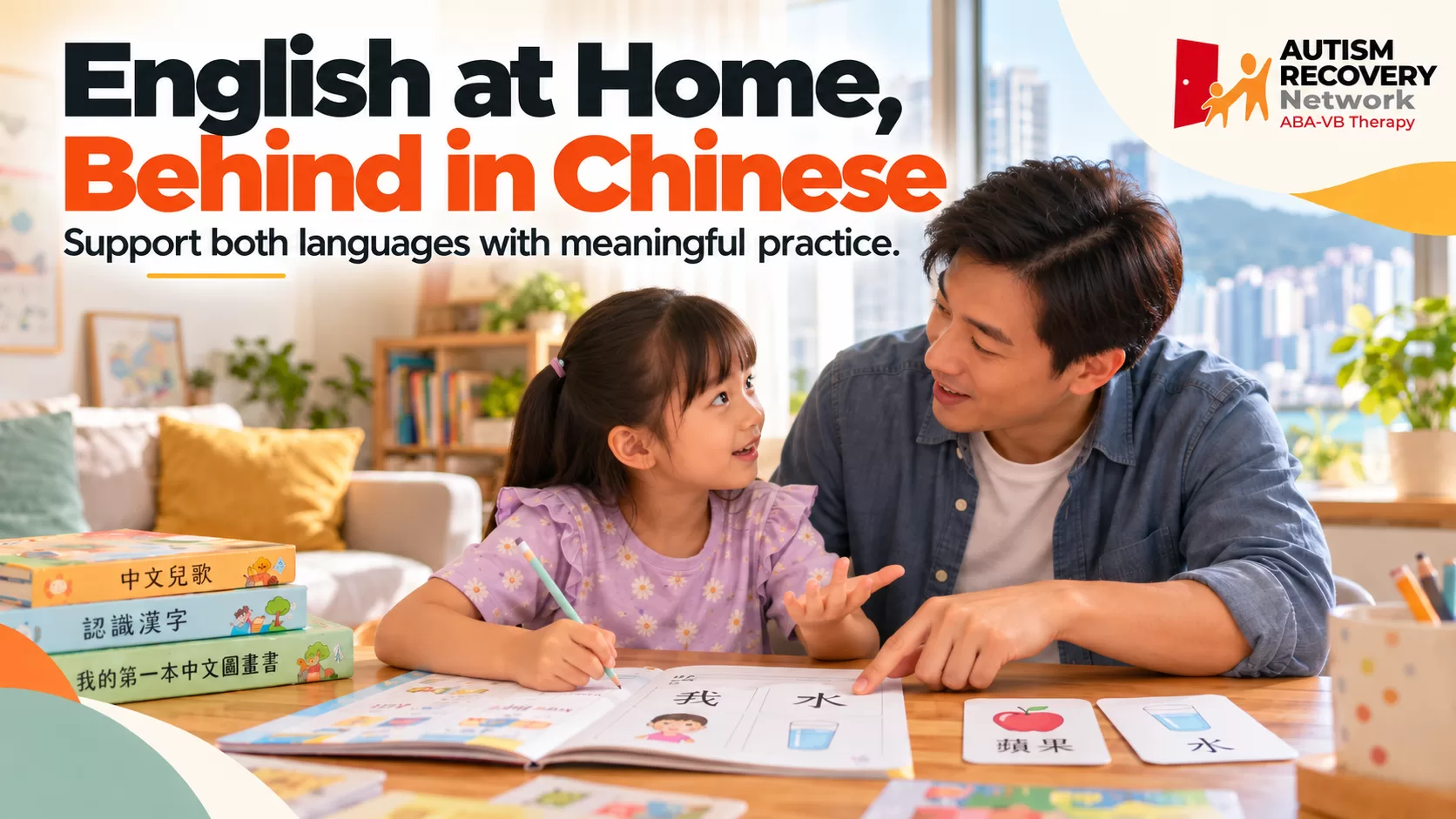
Say 「開門」 while opening the door or point to an object while naming it. This helps connect language with meaning.
3. Read short Chinese picture books together.
Begin with familiar pictures and simple sentences. Talk about the story before expecting independent character recognition.
4. Create reasons to communicate.
Offer choices during play or routines. Accept gestures or partial responses and model a useful Chinese phrase without pressuring your child to repeat perfectly.
5. Practise briefly but consistently.
A few enjoyable minutes each day may be more useful than a long drill. Revisit vocabulary across different activities and people.
What If My Child Has Autism or Language Difficulties?
Autism or developmental delay can add another layer to language learning. A child may have difficulty with comprehension, social communication, attention, flexible responding or using learned skills in a new environment.
However, being much stronger in English than Chinese does not, by itself, mean a child has a language disorder.
For multilingual children with a genuine language disorder, difficulties are generally seen across the languages they use, although they may look different in each language.
If concerns extend beyond Chinese—for example, your child also has difficulty understanding language, expressing ideas or communicating effectively in English—it may be useful to seek professional assessment.
Hong Kong’s Child Assessment Service assesses areas including speech, language and communication, attention, learning and hearing when relevant to the child’s developmental concerns.
How Can ABA-VB Support Communication?
For an autistic child or a child with developmental delays, an individualised ABA-VB programme may support functional communication when this is an identified need.
For example, teaching might help a child learn to request help, answer simple questions, follow useful instructions or use a Cantonese phrase with different people and in different settings.
ABA-VB is not a replacement for Chinese-language teaching or speech and language therapy. The right support depends on why the child is struggling.
Focus on Small, Meaningful Progress
If your child speaks English confidently but finds Chinese difficult, first identify the exact skill that needs support.
Work with the school, provide enjoyable opportunities to practise at home and watch how skills develop over time.
Seek professional advice if difficulties occur across languages, significantly affect everyday communication or learning, or persist despite appropriate opportunities to practise.
Your child does not need perfect Chinese to make progress. Every better-understood instruction, useful phrase and more confident interaction matters.
Need Help Understanding Your Child’s Communication?
Autism Recovery Network provides individualised ABA-VB programmes that may support functional communication, learning, social interaction and the generalisation of skills across home, school and community settings.
ARN also offers a FREE 30-minute parent consultation with an ARN Supervisor. Parents can discuss their child’s communication strengths, concerns about language or learning, and possible next steps, including whether individualised ABA-VB support may be appropriate.
