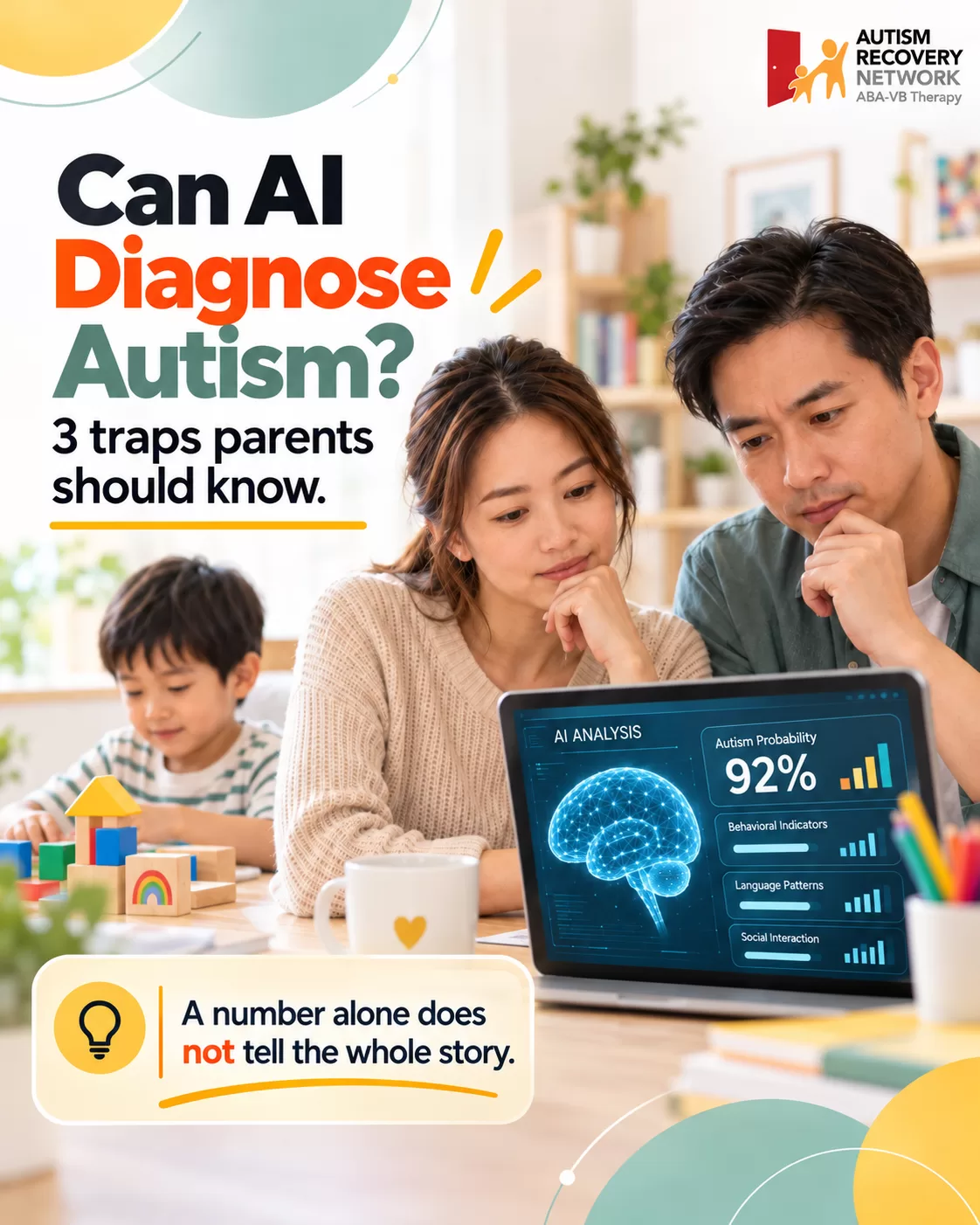
Can artificial intelligence really detect autism with 99% accuracy?
For parents waiting for answers about their child’s development, that number can sound very reassuring. An online tool that promises a quick result may also seem easier than waiting for a professional assessment.
AI is increasingly being studied for autism screening using behavioural information, videos, speech, eye-tracking and other data. Some research has reported impressive results.
But there is an important difference between recognising patterns associated with autism and diagnosing an individual child.
Recent research reviews have found that AI-based autism tools show promise, but their performance varies considerably across datasets and populations, and independent or cross-cultural validation remains an important limitation.
For Hong Kong parents, here are three important traps to avoid.
Trap 1: Thinking “99% Accuracy” Means Your Child Is 99% Likely to Be Autistic
An accuracy figure describes how a system performed in a particular study or dataset. It does not mean that every positive result is 99% certain to be autism.
Parents may see several different statistics:
- Sensitivity: How well does the tool identify autistic children?
- Specificity: How well does it identify children who are not autistic?
- Positive predictive value: If a result is positive, how likely is that result to be correct in the population being tested?
A system can perform extremely well on a carefully selected research dataset but less well when used with children who also have ADHD, language difficulties, anxiety, intellectual disability or other developmental differences.
A recent systematic review found that some retrospective AI studies reported very high performance, while results became more variable with independent and cross-cultural testing.
So instead of asking only:
“How accurate is this AI?”
ask:
“Who was it tested on, and does that group resemble children like mine?”
Trap 2: Assuming Research Results Apply Equally to Hong Kong Children
Autism is highly diverse.
One autistic child may speak fluently but struggle with social situations and flexibility. Another may use little spoken language and need significant support with everyday routines.
AI performance may also be affected by the data used to build the system.
This matters particularly in Hong Kong, where children may use Cantonese, English, Putonghua or several languages across home and school.
Research reviews have highlighted concerns including small samples, demographic bias, limited external validation and differences between populations.
Before placing too much confidence in a result, parents can ask whether the tool has been tested with children of different ages, developmental profiles, languages and cultural backgrounds.
A promising research result does not automatically mean the tool will perform equally well for every child.
Trap 3: Treating AI Screening as a Diagnosis
This is perhaps the most important distinction.
Screening is not the same as diagnosis.
The CDC explains that a brief autism screening tool can identify whether further evaluation may be needed, but it does not itself provide a diagnosis. A formal evaluation may include developmental history, direct observation, structured assessment and information from parents or caregivers.
Hong Kong’s Department of Health similarly states that autism diagnosis requires detailed assessment because other developmental or mental-health conditions can sometimes present with similar features. Its Child Assessment Service involves qualified professionals such as developmental-behavioural paediatricians, clinical psychologists and child psychiatrists in assessment and diagnosis. Hong Kong Child Assessment Service: Autism Spectrum Disorder
AI may eventually help professionals organise information, identify patterns or decide who needs further assessment more quickly.
But AI should currently be viewed as a possible supporting tool—not a replacement for comprehensive professional assessment. PubMed
What Should Parents Do With an AI Result?
If an app or online tool suggests that your child may have autism, avoid treating the result as either a confirmed diagnosis or something to panic about.
Instead, use it as one piece of information.
Record the developmental differences you are noticing. Consider communication, social interaction, play, flexibility, everyday skills and behaviour across different settings. Speak with teachers and appropriate healthcare professionals.
Hong Kong parents who have developmental concerns can approach a doctor or relevant Department of Health service for initial assessment and possible referral to the Child Assessment Service.
Beyond the Diagnosis: What Does Your Child Need?
Whether concerns first arise from a teacher, parent observation, screening questionnaire or AI tool, identifying autism is only part of the picture.
Families also need to understand:
What can my child already do? Where are they struggling? What useful skill should we teach next?
An individualised ABA-VB programme may support skills such as functional communication, social interaction, flexibility, learning, self-help and independence when these are appropriate goals for the individual child.
ABA-VB does not replace diagnostic assessment, and it is not the only support an autistic child may need. Speech and language therapy, occupational therapy, educational support and other services may also be appropriate depending on the child’s profile.
Technology Can Find Patterns—Children Need Understanding
AI may become increasingly useful in autism screening and clinical decision-making.
But an impressive percentage should never replace careful questions about how the system was tested, who it was tested on and what the result actually means.
For parents, the most useful goal is not finding the fastest label.
It is understanding the child behind the data and identifying the support they genuinely need.
Have Questions About Your Child’s Development?
Autism Recovery Network provides individualised ABA-VB programmes focusing on functional communication, learning, social interaction, flexibility, independence and everyday skills according to each child’s needs.
ARN also offers a FREE 30-minute parent consultation with an ARN Supervisor. Parents can discuss developmental concerns, their child’s current strengths and challenges, and possible next steps, including whether individualised ABA-VB support may be appropriate.
