Parents naturally want to do everything they can to give their child the best possible start in life. So when headlines suggest that a common medication taken during pregnancy might increase the risk of autism or ADHD, it is understandable that many expectant parents feel worried.
Recently, this topic resurfaced after the U.S. Court of Appeals for the Second Circuit reopened more than 500 lawsuits involving Tylenol (paracetamol/acetaminophen). News reports and social media quickly spread headlines suggesting that the lawsuits had been “revived,” leaving many families wondering whether this means scientists have finally proven that paracetamol causes autism.
The answer is no.
The court’s decision was about legal procedure—not scientific proof. It did not rule that paracetamol causes autism or ADHD. Instead, the court decided that certain expert testimony should be allowed to be considered in court, allowing the lawsuits to continue. This distinction is important because a court deciding whether evidence can be presented is very different from scientists concluding that a medication causes a medical condition.
The renewed attention also drove public interest. According to Google Trends Hong Kong, searches for “Tylenol autism” became the No. 1 breakout search topic following the court decision. Fortunately, newer and more rigorous scientific research, including a major study led by researchers at The University of Hong Kong (HKU), provides reassuring evidence.
Current scientific evidence does not support the claim that taking paracetamol during pregnancy causes autism or ADHD.
Why Did Earlier Studies Raise Concerns?
Several earlier observational studies found that children whose mothers reported taking paracetamol during pregnancy appeared to have slightly higher rates of autism or ADHD. At first glance, this sounds concerning. However, these studies could not determine whether paracetamol itself was responsible or whether other factors explained the association.
For example, mothers may take paracetamol because they have:
- fever
- infections
- chronic pain
- inflammation
- other medical conditions
These underlying conditions may themselves influence pregnancy outcomes. If researchers do not fully account for these differences, it can appear that the medication caused the outcome when other factors may actually be responsible.
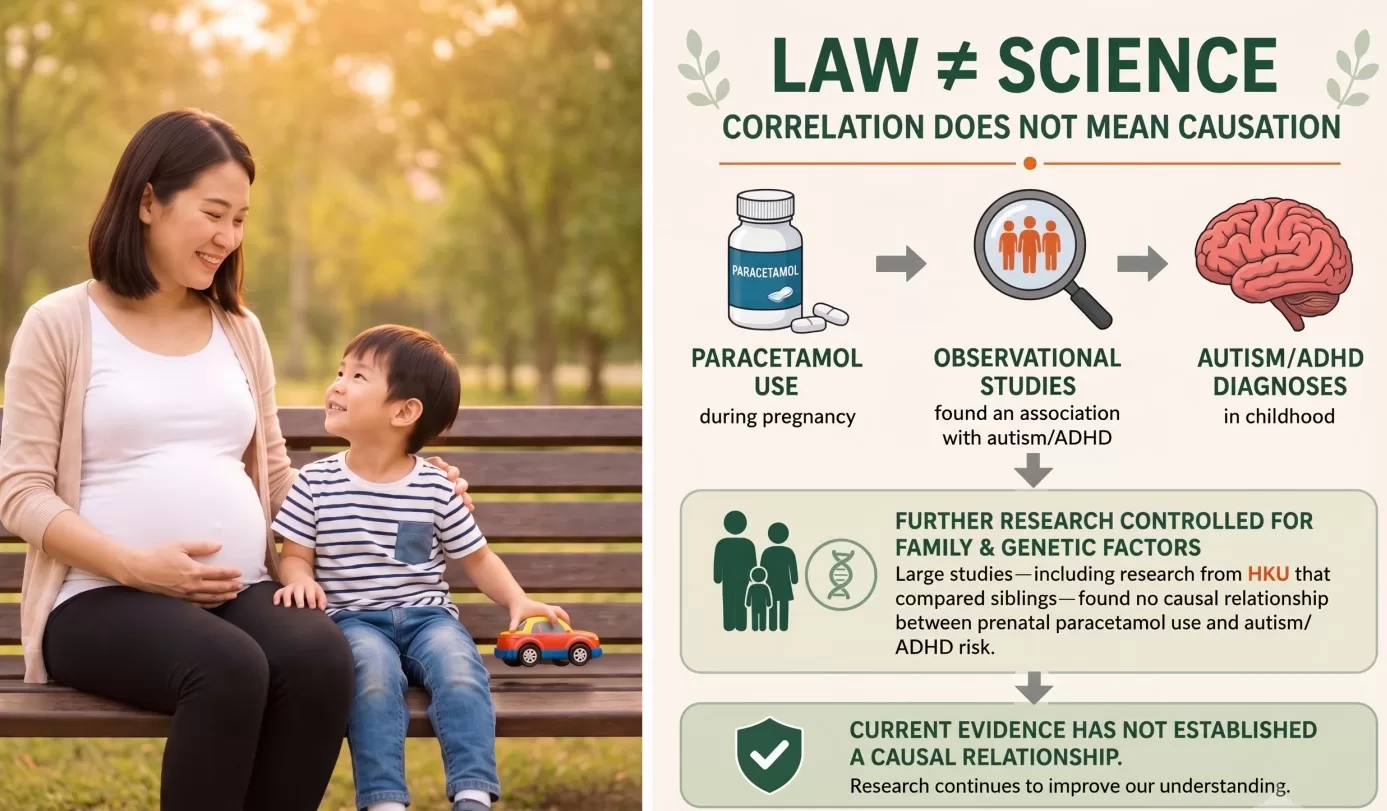
Correlation Does Not Mean Causation
One of the most important concepts in understanding health research is the difference between correlation and causation. A correlation simply means two things occur together more often than expected. It does not automatically mean one caused the other.
For example, children often wear rain boots when it rains. Rain boots and rain happen together, but wearing rain boots does not cause rain.
The same principle applies to many health studies. Finding that two events occur together is only the beginning. Researchers must then determine whether one actually causes the other or whether other explanations better account for the findings.
What Does the Strongest Research Show?
Researchers from The University of Hong Kong conducted one of the largest and most carefully designed studies on this topic.
Rather than simply comparing unrelated families, they also compared siblings within the same family.
This approach is important because brothers and sisters share many of the same:
- genes
- family environment
- socioeconomic background
- early life experiences
By comparing siblings, researchers were able to reduce the influence of many hidden factors that may affect results.
After these family-related factors were taken into account, the apparent association between prenatal paracetamol exposure and autism or ADHD disappeared.
In other words, the study found no evidence that paracetamol itself increased the risk of autism or ADHD.
The findings are consistent with other large studies, including a 2024 systematic review published in The Lancet, which concluded that the current evidence does not support a causal relationship between prenatal paracetamol use and autism or ADHD.
Law and Science Are Not the Same Thing
The recent lawsuits have received significant media attention, but it is important to understand what the court actually decided. The appellate (reviewing) court ruled that certain expert testimony should not have been excluded so early in the legal process, allowing the lawsuits to proceed.
The court did not decide that paracetamol causes autism or ADHD.
Legal proceedings and scientific research answer different questions. A court considers whether evidence meets legal standards and whether a case should proceed. Scientists ask whether research findings can be replicated, whether alternative explanations have been ruled out and whether the overall body of evidence supports a causal relationship.
A lawsuit moving forward does not mean a medical claim has been scientifically proven.
Autism Is Complex
One of the biggest misconceptions surrounding autism is the idea that there is one single cause.
Current scientific understanding tells us that autism is a complex neurodevelopmental condition influenced by many interacting factors. Genetics play a major role, while prenatal development, early brain development and other biological influences may also contribute. There is no single medication, food, vaccine, parenting style or everyday activity that has been proven to cause autism.
This complexity is one reason why scientists are cautious about drawing conclusions from any single study.
How Parents Can Evaluate Health Headlines
Health information spreads quickly, but not all headlines tell the full story.
Before believing or sharing a medical claim, ask yourself:
- Is this reporting a legal case or new scientific research?
- Is the information based on one study or the overall body of evidence?
- Does the study show correlation or actual causation?
- Have independent researchers reached similar conclusions?
- Does the headline accurately reflect what the researchers or court actually said?
These simple questions can help families avoid unnecessary fear caused by misleading or sensational headlines.
What Should Parents Do?
If you are pregnant or planning a pregnancy and have questions about medications, speak with your:
- obstetrician
- family doctor
- midwife
- pharmacist
They can explain the potential benefits and risks based on your individual medical history.
A Balanced Perspective
Parents of children with autism often wonder whether something they did or did not do, caused their child’s diagnosis. These feelings are understandable, especially when media reports appear to suggest new discoveries.
However, the recent U.S. court decision did not conclude that paracetamol causes autism or ADHD, and the strongest available scientific evidence continues to indicate that no causal relationship has been established.
Science evolves as better research becomes available. Large, well-designed studies from HKU and other international researchers now provide reassuring evidence that earlier associations were likely explained by other family and medical factors rather than paracetamol itself.
For parents, the best approach is to rely on high-quality research, discuss medication questions with qualified healthcare professionals and be cautious of headlines that oversimplify complex scientific issues.
By learning to distinguish between legal news, scientific evidence and online misinformation, families can make informed decisions with greater confidence and less unnecessary fear.
References
- The University of Hong Kong. HKUMed finds no increased risk of autism or ADHD in children from prenatal paracetamol use.
- Center for Infectious Disease Research and Policy (CIDRAP). Tylenol during pregnancy doesn’t increase risk of child’s autism or ADHD, study suggests.
- The Lancet. Systematic review of prenatal acetaminophen exposure and neurodevelopmental outcomes (2024).
- The BMJ. Reviews on prenatal paracetamol exposure and neurodevelopmental outcomes.
- Reuters. U.S. appeals court revives lawsuits linking Tylenol to autism and ADHD (July 13, 2026).
Important Disclaimer
This article is intended for educational purposes only and should not be interpreted as medical advice. If you have questions about taking medications during pregnancy, always consult your obstetrician, family doctor or pharmacist. Autism Recovery Network (ARN) does not provide assessment or advice regarding pregnancy-related medication use or risks.
