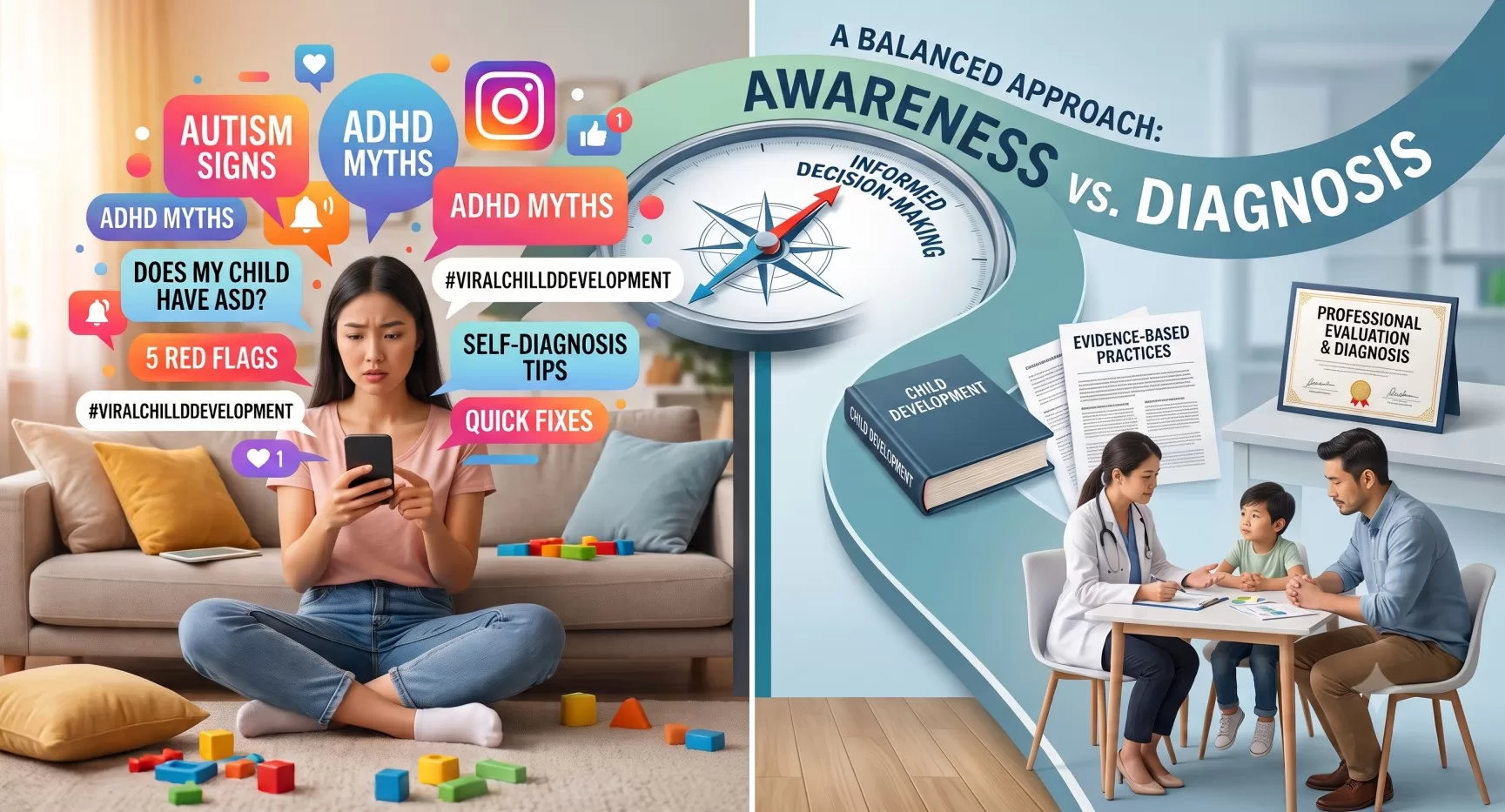
Social media has changed the way families learn about child development. With just a few taps, parents can access thousands of videos, posts and personal stories about autism, ADHD, speech delays, sensory differences and other developmental concerns.
For many families, online content can be the first step toward recognizing that a child may need additional support. Parents often report that social media introduced them to signs and experiences they had never encountered before.
In this way, online platforms can play a valuable role in raising awareness and helping families feel less alone.
However, awareness and diagnosis are not the same thing.
As developmental information becomes increasingly available online, parents are faced with an important challenge: how to determine which information is reliable and how to make informed decisions that support their child’s long-term development.
The Growing Concern About Developmental Information Online
Recent studies examining autism and ADHD content on social media platforms have found that a significant portion of highly viewed content contains inaccuracies, oversimplifications or unsupported claims.
This does NOT mean that all online content is wrong. Many individuals with autism, parents, professionals and advocates share valuable experiences and insights. However, personal experiences are not the same as professional assessments and individual stories do not always apply to every child.
Children develop in different ways and for different reasons. A behavior that may be associated with autism in one child may have a completely different explanation in another.
This is why developmental concerns require a broader evaluation than a short video or online checklist can provide.
Why Accurate Information Matters
When parents are worried about their child’s development, they are often looking for answers as quickly as possible. The information they encounter online can significantly influence important decisions, including:
- Whether to seek an assessment
- Whether to begin intervention services
- Which therapies to pursue
- Whether to continue or discontinue support
- Expectations about a child’s future development
Accurate information can help families make timely decisions that benefit their child. Inaccurate information, however, may unintentionally delay support or create confusion during a critical period of development.
For example, some parents may be reassured by online content suggesting that a child will simply “grow out of it,” while others may become unnecessarily anxious after seeing generalized lists of symptoms that seem to describe almost every child.
Neither of this is helpful.
The goal is not to create fear or urgency without reason. The goal is to ensure that families have enough reliable information to make informed choices.
The Risks of Relying Solely on Self-Diagnosis
Many online videos encourage viewers to compare themselves or their children to a list of traits and determine whether autism may be present. While these discussions can increase awareness, they cannot replace a comprehensive developmental evaluation.
Autism is a complex neuro-developmental condition that affects communication, social interaction, behavior and daily functioning in different ways for different individuals. A diagnosis requires consideration of developmental history, observations across settings, clinical assessment and input from caregivers and professionals.
When families rely solely on self-diagnosis or social media content, several challenges may occur:
Delayed Access to Support
Parents may postpone seeking professional guidance because they believe they already have all the answers. Valuable time that could be used for intervention and skill development may be lost.
Misidentification of Challenges
Some developmental concerns may appear similar on the surface but require different supports. Difficulties with communication, attention, anxiety, hearing, learning or sensory processing can sometimes resemble autism-related behaviors.
Without proper assessment, families may pursue interventions that do not fully address their child’s needs.
Increased Stress and Uncertainty
Contradictory information online can leave parents feeling overwhelmed. One video may recommend a particular approach, while another strongly discourages it. This can make decision-making more difficult rather than easier.
The Five Red Flags to Watch for Online
When evaluating developmental information online, parents can ask a few simple questions.
1. No Sources or Evidence Are Provided
Reliable information should have reference research, clinical expertise, professional organizations or established developmental frameworks. Be cautious when strong claims are presented without any supporting evidence.
2. Someone Is Primarily Trying to Sell a Product
While educational content and services can be valuable, parents should be careful when information is tied directly to products, supplements, programs or quick-fix solutions.
If the main objective seems to be making a sale rather than offering education, it’s worth taking a closer look and have it checked further.
3. Instant Diagnosis Claims
Statements such as “If your child does this, they definitely have autism” oversimplify a complex process.
No single behavior, video, quiz or checklist can confirm a diagnosis.
4. Correlation Is Presented as Proof
Just because two things occur together does not mean one causes the other.
Developmental conditions are influenced by multiple factors and simple explanations often fail to capture the complexity of child development.
5. Professional Assessment Is Dismissed Entirely
Families should be cautious of content that suggests assessments, developmental evaluations or professional guidance are unnecessary.
Good information encourages parents to gather more information and seek appropriate support when concerns exist.
No Online Test Can Diagnose Autism
Online screening tools can sometimes help parents identify developmental concerns that deserve further attention. However, screening tools are designed to indicate whether further evaluation may be helpful, they are not diagnostic instruments.
A child may score high on a screening questionnaire and not meet criteria for autism. Likewise, a child may score lower yet still benefit from a comprehensive evaluation. The purpose of screening is to guide next steps, not to provide definitive answers.
How Misinformation Can Affect a Child’s Future
The most important issue is not whether a parent encounters misinformation. Most parents will at some point. The greater concern is how that information influences decisions during critical developmental years.
Research consistently shows that early identification and appropriate intervention can support communication, social skills, independence, learning and participation in everyday life.
When families delay assessments or services because of inaccurate information, children may miss opportunities to build foundational skills during periods of rapid development.
At the same time, rushing into interventions based solely on social media recommendations may lead families toward approaches that are not evidence-based or appropriate for their child’s needs.
Thoughtful, informed decision-making creates the strongest foundation for future progress.
When Should Parents Seek a Professional Evaluation?
Consider seeking professional guidance if you notice persistent concerns related to:
- Speech and language development
- Social interaction and communication
- Play skills
- Behavioral regulation
- Sensory responses
- Learning and attention
- Daily living skills
- Developmental milestones
Seeking an evaluation does not automatically mean a child will receive a diagnosis. Instead, it provides families with a clearer understanding of their child’s strengths, needs, and potential next steps.
A Balanced Approach for Families
Social media can be a useful starting point for learning, connecting with others and increasing awareness. Many families have discovered valuable information and supportive communities through online platforms.
However, online content works best as a starting point, not the final answer.
The most effective decisions are typically made when parents combine personal observations, reliable information, professional guidance and a clear understanding of their child’s individual needs.
Every child deserves support based on a comprehensive understanding of who they are, not on a viral video, a trending checklist or a quick online quiz.
By approaching online information thoughtfully and seeking professional guidance when needed, families can make informed decisions that support both their child’s current needs and their long-term future.
