
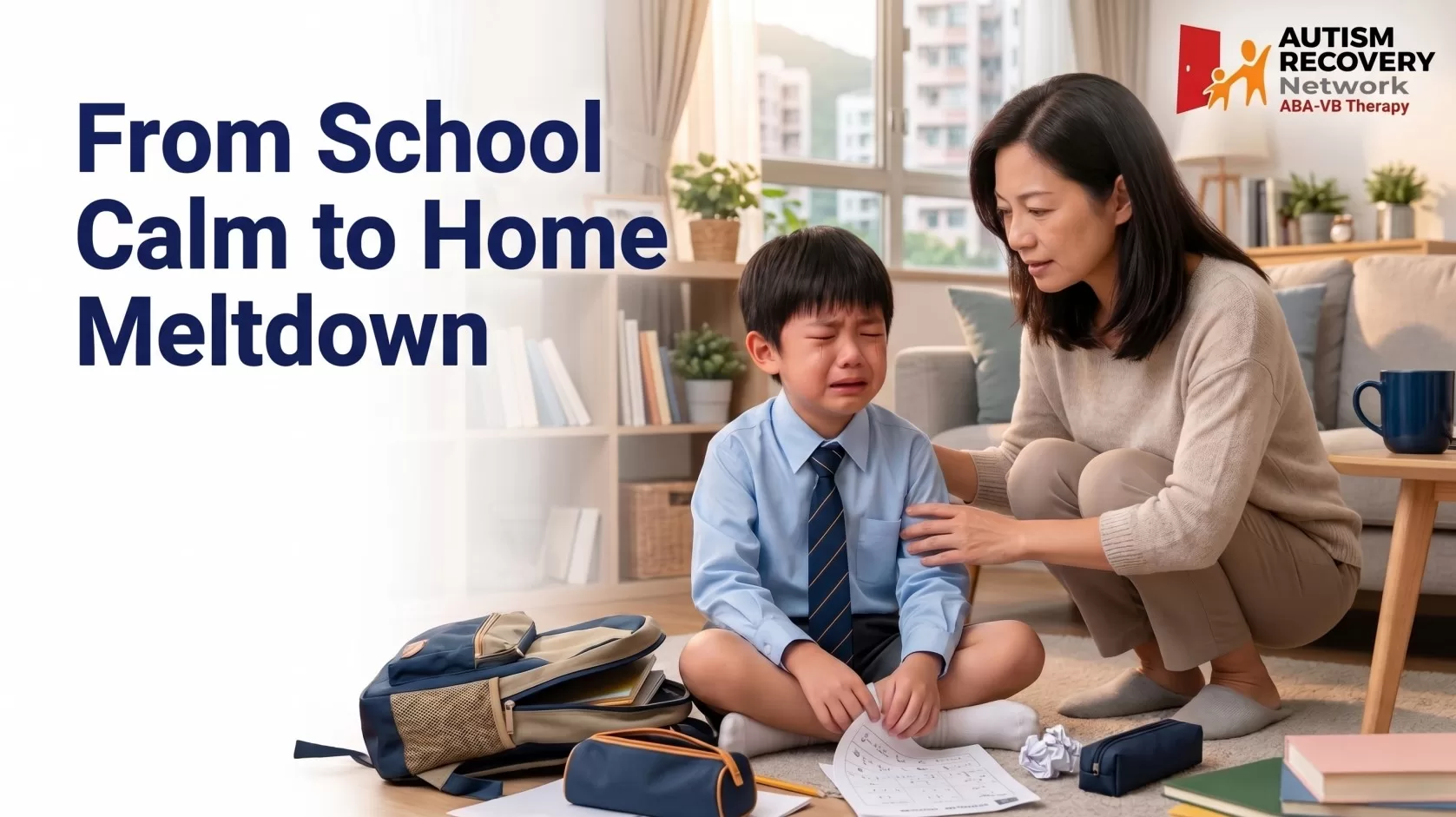
“His teacher said he had a great day. So why does he fall apart the moment we get home?”
For some parents, this situation feels very familiar.
At school, the child may participate well, follow instructions, and appear calm. Then, once they get home, they may cry, scream, refuse simple requests, become very active, hide, or show challenging behaviour.
Parents may naturally wonder:
“What happened at school?”
“Why can my child cope there but not at home?”
One term sometimes used to describe this pattern is after-school restraint collapse.
It is important to know that this is an informal descriptive term—not a medical diagnosis or a symptom of autism. It describes what may happen when a child manages the demands of the school day but struggles once they return to a familiar environment.
A similar pattern may also happen after therapy sessions, tutoring, social activities, or other structured learning situations.
Why Can After-School Meltdowns Happen?
A school day involves much more than academic work.
Children may need to:
- Follow instructions
- Wait and take turns
- Communicate with teachers and classmates
- Move between activities
- Cope with noise and busy environments
- Handle unexpected changes
- Stay focused for long periods
For some autistic children, communication differences, sensory sensitivities, difficulty with flexibility, or developing emotional regulation skills can make these demands especially tiring.
By the end of the day, hunger, tiredness, noise, homework, siblings, or another transition may feel much harder to manage.
However, not every after-school meltdown has the same cause. It is important to look at the individual child and what happened before the behaviour.
What Can It Look Like at Home?
After-school difficulties may include:
- Crying, yelling, or screaming
- Refusing homework or routines
- Becoming frustrated very quickly
- Throwing objects
- Aggressive or unsafe behaviour
- Running, jumping, or pacing
- Hiding or withdrawing
- Becoming unusually quiet
Instead of asking only:
“How do I stop this behaviour?”
Try asking:
“What might my child need right now?”
That question often leads to more useful support.
5 Things Parents Can Try
1. Give Your Child Time to Decompress
Avoid immediately asking lots of questions or starting homework.
A short period of quiet time, movement, a preferred activity, or fewer demands may help your child settle after a long day.
2. Check the Basics
Ask yourself whether your child may be hungry, thirsty, tired, or overstimulated.
Sometimes a snack, drink, rest, or quieter environment can make a big difference.
3. Reduce Unnecessary Demands
When your child already appears overwhelmed, avoid giving several instructions at once.
Instead of:
“Take off your shoes, put away your bag, wash your hands, and start homework.”
Try one step at a time.
4. Connect Before Correcting
When emotions are high, long explanations may be difficult to process.
Keep your voice calm and language simple:
“You’re home now. Let’s take a break.”
If behaviour is unsafe, focus on safety first. Teaching can happen later when the child is calmer.
5. Teach Useful Skills During Calm Moments
Children can practise skills such as:
- Asking for help
- Requesting a break
- Saying or signalling “finished”
- Waiting
- Coping with small changes
- Moving between activities
- Communicating discomfort
The goal is to give the child more effective ways to respond when situations feel difficult.
Look for Patterns, Not Just Problems
If after-school meltdowns happen frequently, keep a simple record for one or two weeks.
Write down:
- What happened before the behaviour
- What the child did
- What happened afterwards
- What helped them recover
Also consider sleep, hunger, school changes, sensory demands, homework, therapy sessions, and changes in routine.
Over time, patterns may become clearer.
For example, you may notice that meltdowns are more likely on days with poor sleep, schedule changes, difficult school activities, or demanding therapy sessions.
How Can ABA-VB Help?
When challenging behaviour happens regularly, the goal should not simply be to make it stop.
An individualised ABA-VB programme can help identify what may be contributing to the behaviour and teach skills that make daily situations easier to manage.
Depending on the child’s needs, therapy may work on:
- Functional communication
- Requesting help or breaks
- Waiting
- Transitions
- Flexibility
- Following routines
- Coping skills
Parent involvement is also important so that useful strategies can be practised at home and in other everyday settings.
When Should Parents Seek Additional Support?
Consider speaking with your child’s therapist, doctor, or another appropriate professional if episodes involve:
- Frequent aggression
- Self-injury
- Running away or other safety risks
- Severe or prolonged distress
- Significant withdrawal
- Major disruption to eating, sleeping, school, or family life
A sudden change in behaviour should also be discussed with a professional rather than automatically being labelled as restraint collapse.
A Difficult Afternoon Does Not Mean a Difficult Child
A child who copes well at school but struggles at home is not necessarily being “better behaved” for teachers or deliberately difficult for parents.
Instead, the behaviour may be telling us:
“Something about this moment is hard for me.”
With observation, predictable routines, lower demands when appropriate, and the teaching of practical coping and communication skills, children can gradually learn better ways to handle difficult moments.
The goal is to move from:
“I can’t cope with this.”
towards:
“I know how to ask for help.”
