What does it really mean when your child is diagnosed with Level 1, Level 2 or Level 3 autism?
These levels are not labels for your child’s intelligence, personality or potential. They describe how much support your child may currently need in everyday life.
Here is a simple, parent-friendly guide to understanding autism support levels.
Are There Different Types of Autism?
Today, autism is diagnosed under one main name: Autism Spectrum Disorder (ASD).
In the past, autism-related conditions were diagnosed separately, including Autistic Disorder, Asperger’s Disorder and PDD-NOS. Under the DSM-5, these diagnoses were brought together under Autism Spectrum Disorder.
The word “spectrum” reflects how differently autism can affect each person. Children may have different strengths and challenges in communication, social interaction, learning, sensory processing, behaviour and independence. (National Institute of Mental Health)
Rather than dividing autism into separate “types,” clinicians consider how autism affects the individual and how much support they need.
What Are the 3 Autism Support Levels?
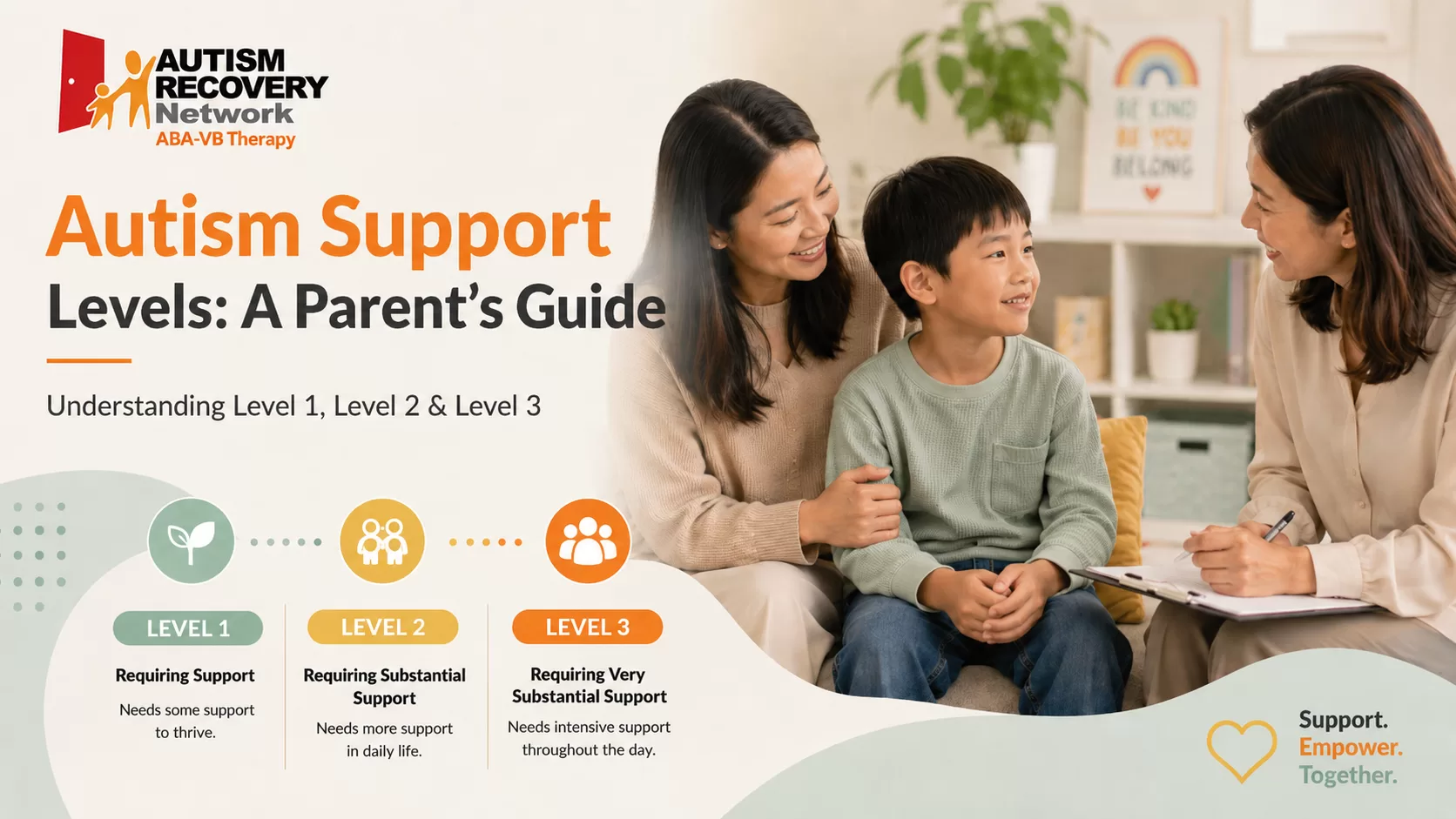
The DSM-5 describes three support levels:
| Support Level | Description |
| Level 1 | Requires support |
| Level 2 | Requires substantial support |
| Level 3 | Requires very substantial support |
These levels consider support needs in two main areas:
- Social communication and interaction
- Restricted or repetitive behaviours, interests and routines
(CDC)
Level 1 Autism: Requires Support
A child at Level 1 may speak in sentences and manage many daily activities independently but still experience noticeable difficulties.
They may:
- Find conversations or social cues difficult
- Struggle with friendships or group situations
- Become anxious when routines change
- Have strong or highly focused interests
- Need help with flexibility, organisation or emotional regulation
These challenges may become more noticeable as school and social expectations increase.
Level 1 does not mean a child does not need support. Their difficulties may simply be less obvious to others.
Level 2 Autism: Requires Substantial Support
Children at Level 2 usually need more regular and structured support.
They may:
- Have clearer difficulties with verbal and non-verbal communication
- Initiate or respond to social interaction less often
- Struggle significantly with changes and transitions
- Show repetitive behaviours or strong interests that interfere with daily activities
- Need regular assistance at home, school or in the community
Support may focus on communication, social skills, behaviour, learning, independence and daily living skills. (American Psychiatric Association)
Level 3 Autism: Requires Very Substantial Support
A child at Level 3 has significant support needs across many areas of daily life.
They may:
- Have limited spoken communication or use alternative communication methods
- Rarely initiate social interaction
- Have significant difficulty responding to others
- Experience intense distress with changes in routine
- Show repetitive behaviours that strongly affect daily activities
- Need extensive support with communication, safety, learning or self-care
The aim of support is not to make a child appear “less autistic.” It is to help them communicate, participate, develop useful skills and become as independent as possible.
Autism Levels Are Not the Same as Intelligence
A common misconception is that Level 1 means “more intelligent” and Level 3 means “less intelligent.”
That is not what the levels measure.
Clinicians can separately describe whether autism occurs with or without intellectual or language impairment. (CDC)
A child may be academically strong but need significant help with social communication, flexibility or emotional regulation. Another child may have limited spoken language but show strengths in visual learning, technology, music, puzzles or other areas.
Can a Child’s Autism Level Change?
Support levels describe a person’s current support needs and should not be treated as a permanent prediction of their future.
A child’s needs may change as they develop, learn new skills or move into different environments. Clinicians may also reassess severity when appropriate. (American Psychiatric Association)
Support needs can also vary by setting. A child may cope well at home but need much more help in a busy classroom, during transitions or in unfamiliar social situations.
Look Beyond the Autism Level
After a diagnosis, it is natural to ask:
“What level is my child?”
But an even more useful question is:
“What does my child need help with right now?”
Important areas may include:
- Communication and understanding language
- Conversation and social interaction
- Play skills
- Emotional regulation
- Flexibility and transitions
- Attention and learning readiness
- Behaviour and safety
- Toileting, dressing and self-help skills
- Independence at home, school and in the community
Two children with the same autism level can have very different strengths, challenges and intervention needs.
What Should Parents Do Next?
Use your child’s assessment as a starting point for understanding their individual needs rather than focusing only on the level.
Ask the professionals working with your child:
- What can my child already do independently?
- Which difficulties are affecting daily life the most?
- Which skills should we prioritise first?
- What can we practise at home?
- How will progress be measured?
The best support plan focuses on your child’s communication, behaviour, learning, independence, strengths and everyday needs.
Not Sure What Support Your Child Needs?
Understanding an autism diagnosis can be confusing, especially when you are deciding what to do next.
Autism Recovery Network (ARN) offers a FREE 30-minute Parent Consultation for parents who would like to discuss their child’s development, current difficulties and possible next steps.
Parents can discuss concerns involving:
- Communication and language
- Social interaction
- Behaviour and emotional regulation
- Learning difficulties
- Independence and self-help skills
- Autism intervention and support options
You do not need to have everything figured out before speaking with us. The consultation can be a starting point for understanding your child’s needs and deciding what support may be appropriate.
The Key Takeaway
Level 1, Level 2 and Level 3 are autism support levels—not measures of a child’s intelligence or potential.
They describe how much support a person may currently need, but no single number can fully describe your child.
Understanding the diagnosis matters. Understanding your individual child matters even more.
