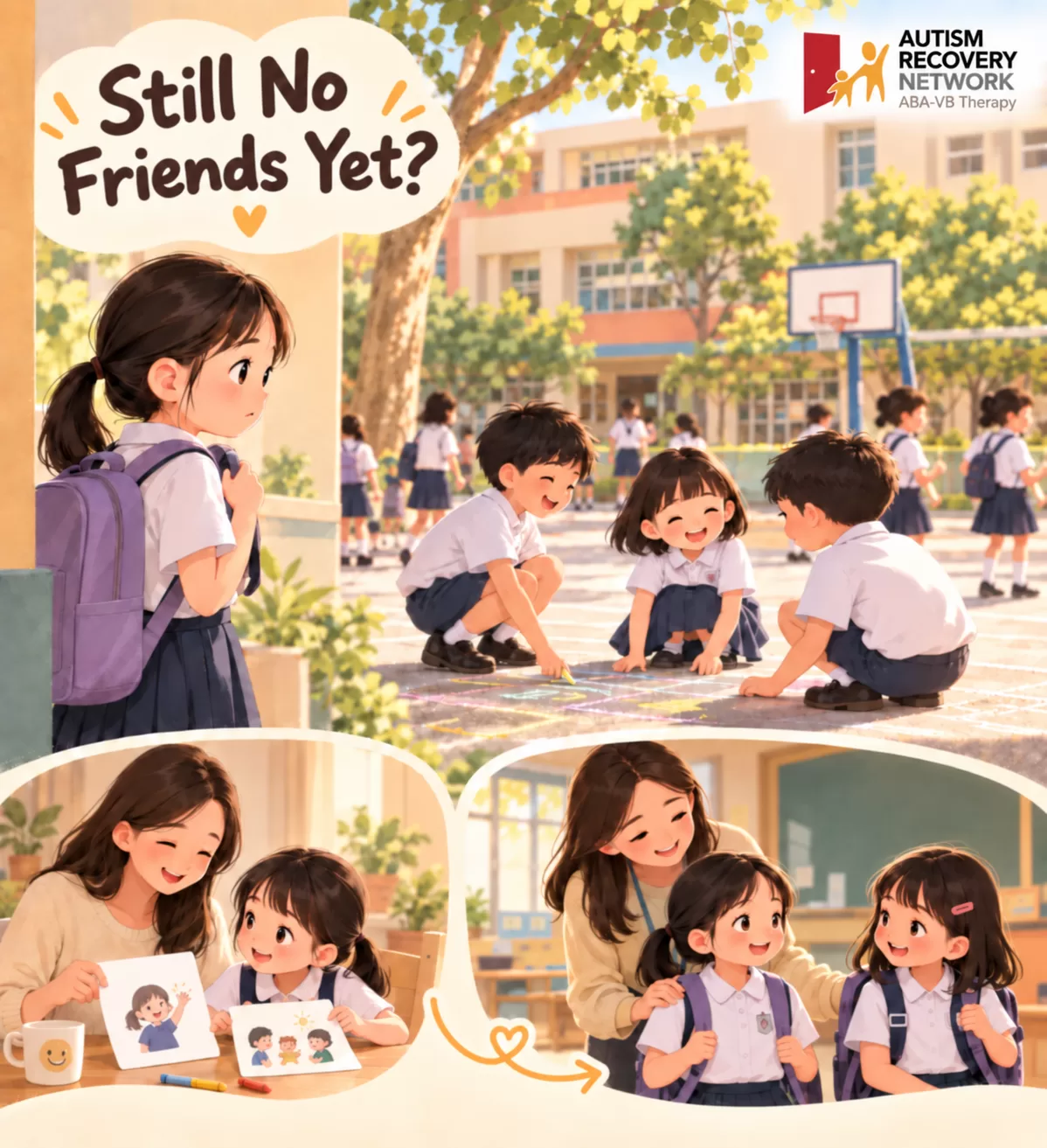
Two weeks into the school term, some parents may already be wondering:
“Why does my child still have no friends at school?”
For autistic children or children with social communication difficulties, friendships may not develop simply because they are surrounded by classmates.
A child may genuinely want to connect but find it difficult to start a conversation, join a game, understand social cues, or know what to do when another child responds unexpectedly.
Social communication and interaction can be challenging for autistic children, although every child’s strengths and needs are different.
So rather than telling a child to “just go and make friends,” it can be more helpful to identify which part of friendship is difficult.
1. Understand Behaviours Other Children May Misread
Sometimes a child’s behaviour sends a different message from what they intend.
Walking away from group play may look unfriendly, even though the child feels overwhelmed or does not know how to join.
Talking repeatedly about a favourite topic may appear one-sided, while the child may actually be trying to connect through something familiar.
Standing beside a group without joining may look like disinterest, but the child may be waiting because they do not know what to say.
Instead of assuming “My child doesn’t want friends,” ask:
“Is there a social skill they have not learned yet?”
2. Does Your Child Want to Join—or Need a Break?
Not every child wants constant social interaction.
Some children enjoy classmates but also need quiet time after busy lessons. Therefore, the goal should not be to force a child to socialise every moment.
Signs that your child may want more connection include:
- Watching classmates closely
- Talking about particular children at home
- Moving towards group activities
- Asking about parties or playdates
- Becoming upset when they are left out
Try to distinguish between:
“I want to join, but I don’t know how.”
and:
“I need some space right now.”
Both are valid.
3. Ask the School for Specific Support
Instead of saying only:
“Please help my child socialise.”
ask about practical opportunities such as:
- A supportive buddy during selected activities
- Teacher-supported playground games
- Small-group activities
- Seating near helpful classmates
- Clubs based on your child’s interests
Research on peer-mediated interventions suggests that structured involvement from classmates can support social initiation, responses and interaction for some autistic children.
Hong Kong’s Education Bureau also provides tiered support for autistic students, including small-group training aimed at social communication, interpersonal skills and emotional adjustment.
Structured opportunities can make social situations feel more predictable and manageable.
4. Practise Friendship Skills at Home
Children often benefit from practising a difficult social situation before it happens in real life.
Parents can role-play simple phrases such as:
“Can I play too?”
“What are you playing?”
“Do you want to sit together?”
Other useful skills to practise include:
- Taking turns in conversations
- Asking another person a question
- Changing topics
- Coping when someone says “no”
- Sharing ideas
- Noticing when another person wants a turn
- Asking for help when unsure
Social communication involves more than speaking. It also includes understanding context, another person’s perspective, and the unwritten rules of interaction.
Short, regular practice is usually more useful than repeatedly telling a child to “be more social.”
5. Know When Additional Support May Help
Consider seeking professional advice if your child repeatedly wants friendships but:
- Does not know how to join others
- Experiences frequent rejection or conflict
- Becomes anxious about school
- Has difficulty understanding social situations
- Relies heavily on adults during peer interactions
An individualised ABA-VB programme may help teach social interaction step by step.
Depending on your child’s needs, goals may include conversation, turn-taking, flexible thinking, perspective-taking, coping with losing, recognising social cues, and practising situations that happen at school.
Just as importantly, skills should eventually be used with different people and in real-life settings, not only during therapy.
Friendship Is a Skill That Can Grow
Not having close friends during the first few weeks of school does not mean your child will never develop friendships.
Some children simply need more time, clearer opportunities and more explicit teaching about how social situations work.
Instead of asking only:
“Why doesn’t my child have friends?”
try asking:
“What part of connecting with other children is difficult, and what can we teach next?”
That question gives parents, teachers and therapists something practical to work on.
Concerned About Your Child’s Social Development?
If your child wants to connect with classmates but struggles with conversation, joining groups, flexibility or understanding social situations, Autism Recovery Network offers a FREE 30-minute parent consultation with our Programme Supervisors.
Parents can discuss their child’s current social strengths and challenges and explore whether an individualised ABA-VB programme may help them develop more confident, practical social skills.
