Can Folic Acid Cure Autism? What Parents Need to Know
Searches for “folic acid and autism” have increased as parents encounter videos, articles and social media posts claiming that folic acid can “reverse” or even “cure” autism.
For families looking for ways to support their child, these claims can sound hopeful and convincing. But are they supported by reliable evidence?
Let’s separate the facts from the hype.
Why Is Folic Acid Being Discussed?
Folate, also known as vitamin B9, is essential for healthy cell growth and early brain and nervous system development. Folic acid is a manufactured form of folate commonly found in supplements, fortified foods and prenatal vitamins.
Doctors recommend folic acid before and during early pregnancy because it helps prevent serious neural tube defects, including spina bifida. However, this well-established benefit does not mean that folic acid can treat or cure autism.
Some online posts claim that:
- Folic acid can cure autism.
- Children with autism simply have a folate deficiency.
- Large doses of folate can eliminate autistic characteristics.
These statements oversimplify a much more complex area of research.
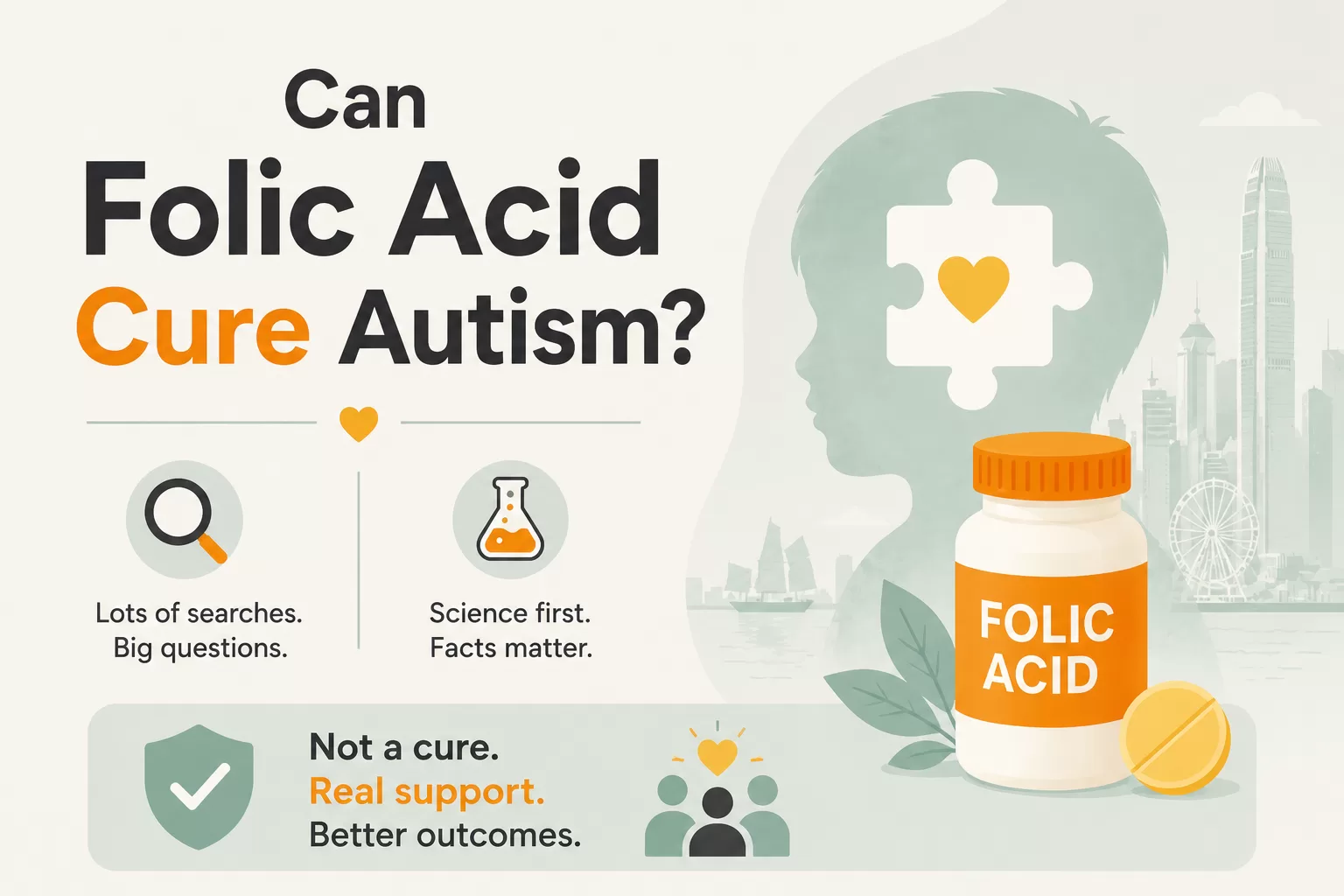
The Clear Answer: No
There is no scientific evidence that ordinary folic acid cures autism.
Autism is a neurodevelopmental condition with diverse presentations. Research suggests that genetic, biological and environmental factors may all influence early brain development. There is no single known cause, and no vitamin, supplement, medication or diet has been proven to cure autism.
Be cautious whenever someone promises a quick or universal cure—especially when the claim is based mainly on testimonials, product promotions or social media content.
Why Are Researchers Studying Folate?
Some research is examining whether a specific form of folate may help certain children with identified medical or metabolic differences.
One condition receiving attention is cerebral folate deficiency, or CFD. This is a neurological condition in which adequate folate does not reach the brain. Some people with CFD experience developmental delays, seizures, movement difficulties or autism-like characteristics.
Researchers have also studied folate receptor alpha autoantibodies, known as FRAAs. These antibodies may interfere with the way folate is transported into the brain. However, testing and interpretation remain complex, and the clinical importance of FRAAs is not yet fully understood.
In selected cases, doctors may consider folinic acid, also called leucovorin. This is not the same as the folic acid found in regular vitamin supplements.
Folic Acid and Folinic Acid Are Different
Folic Acid
- A common form of vitamin B9
- Found in supplements and prenatal vitamins
- Helps prevent neural tube defects during pregnancy
- Not proven to treat or cure autism
Folinic Acid or Leucovorin
- A prescription form of folate
- Used for certain medical conditions
- Enters folate-related biological pathways differently
- Being studied in selected groups of children with autism
- Not a general treatment or cure for autism
This distinction is often missing from viral posts, making early research on leucovorin sound like proof that ordinary folic acid treats autism.
What Is Leucovorin Approved For?
In March 2026, the US Food and Drug Administration approved leucovorin for children and adults with confirmed cerebral folate transport deficiency caused by a variant in the FOLR1 gene.
This approval was for a rare and specific genetic condition—not for autism generally. Although some people with this condition may have developmental delays with autistic features, the approval should not be interpreted as evidence that leucovorin cures autism.
The American Academy of Pediatrics does not currently recommend leucovorin as a routine treatment for children with autism. Existing studies are small, and important questions remain about who may benefit, appropriate dosing, long-term safety and how progress should be measured.
Clinical trials are still underway to evaluate whether folinic acid may help certain children and to identify which biological profiles are most likely to respond.
Why Do Some Parents Report Improvements?
Parents may share experiences such as:
“My child started talking after taking folate.”
These experiences may be genuine and meaningful to the families involved. However, an individual story cannot prove that folate caused the improvement or cured autism.
Other possible explanations include:
- The child was already progressing developmentally.
- Therapy or educational support was helping.
- Several interventions began at the same time.
- The child had a specific medical condition that responded to treatment.
- The improvement occurred naturally over time.
This is why researchers use controlled clinical studies. They help determine whether an improvement was truly caused by a treatment and whether it is safe and effective for other children.
Could Taking Extra Folic Acid Be Harmful?
Folic acid is generally safe when taken at recommended levels. However, more is not always better.
Taking large amounts without medical guidance may mask a vitamin B12 deficiency and may interact with certain medications. Prescription folinic acid also requires careful monitoring because its effects can be positive, neutral or negative depending on the child’s health and biology.
Before giving your child a high-dose supplement or prescription folate product, speak with a paediatrician, developmental specialist or another qualified medical professional.
Do not replace established services with a supplement based only on online advice.
What Support Has Stronger Evidence?
While research into nutrition, genetics and folate metabolism continues, children can benefit now from support based on their individual strengths and needs.
Depending on the child, this may include:
- Individualised behavioural intervention
- Speech and language therapy
- Occupational therapy
- Parent coaching
- Structured teaching and learning opportunities
- Social communication support
- Daily living and independence training
These approaches do not promise overnight changes. Their purpose is to help children build practical communication, learning, social, emotional and independence skills over time.
Evidence-based psychosocial interventions can improve communication and social skills while supporting the well-being of children and their families.
Hope Should Be Built on Evidence
Every parent wants to give their child the best possible opportunities. It is understandable that stories about a new treatment can create excitement and hope.
Research continues to advance. Scientists are learning more about genetics, brain development, metabolism and the different biological profiles found among people with autism. In the future, this may lead to more personalised treatments for particular medical needs.
However, promising research is not the same as proven treatment.
Families deserve information that is honest about both the possibilities and the limitations.
The Bottom Line
Does folic acid cure autism? No.
Current evidence shows that:
- Ordinary folic acid has not been proven to cure or treat autism.
- Folic acid and folinic acid are not the same.
- Leucovorin is approved for a rare, confirmed folate transport disorder—not autism generally.
- Small studies suggest that selected children may benefit, but the evidence remains limited.
- The American Academy of Pediatrics does not recommend routine leucovorin treatment for autism.
- Supplements and prescription treatments should always be discussed with a qualified healthcare professional.
When you see a bold health claim online, ask:
“Is this supported by high-quality research, or is it offering hope without enough evidence?”
That question can help families make safer, more informed decisions.
Looking for Guidance Instead of Guesswork?
Every child with autism has a unique combination of strengths, developmental needs and challenges. Rather than relying on viral trends or one-size-fits-all claims, the first step is understanding what your child needs most right now.
At Autism Recovery Network (ARN), we focus on evidence-based assessment and individualised intervention—not miracle cures. Our team can help you understand your child’s developmental profile and develop practical goals that support meaningful progress.
Book a FREE 30-minute consultation to discuss your child’s needs and receive professional guidance based on science, understanding and compassion.
This article is for general educational purposes and does not replace individual medical advice, diagnosis or treatment.
