When parents hear the words “early intervention,” one question often follows:
“When does it end?”
Some programmes have age limits, but reaching a certain birthday does not mean a child has finished learning or no longer benefits from support.
A more useful way to think about it is this:
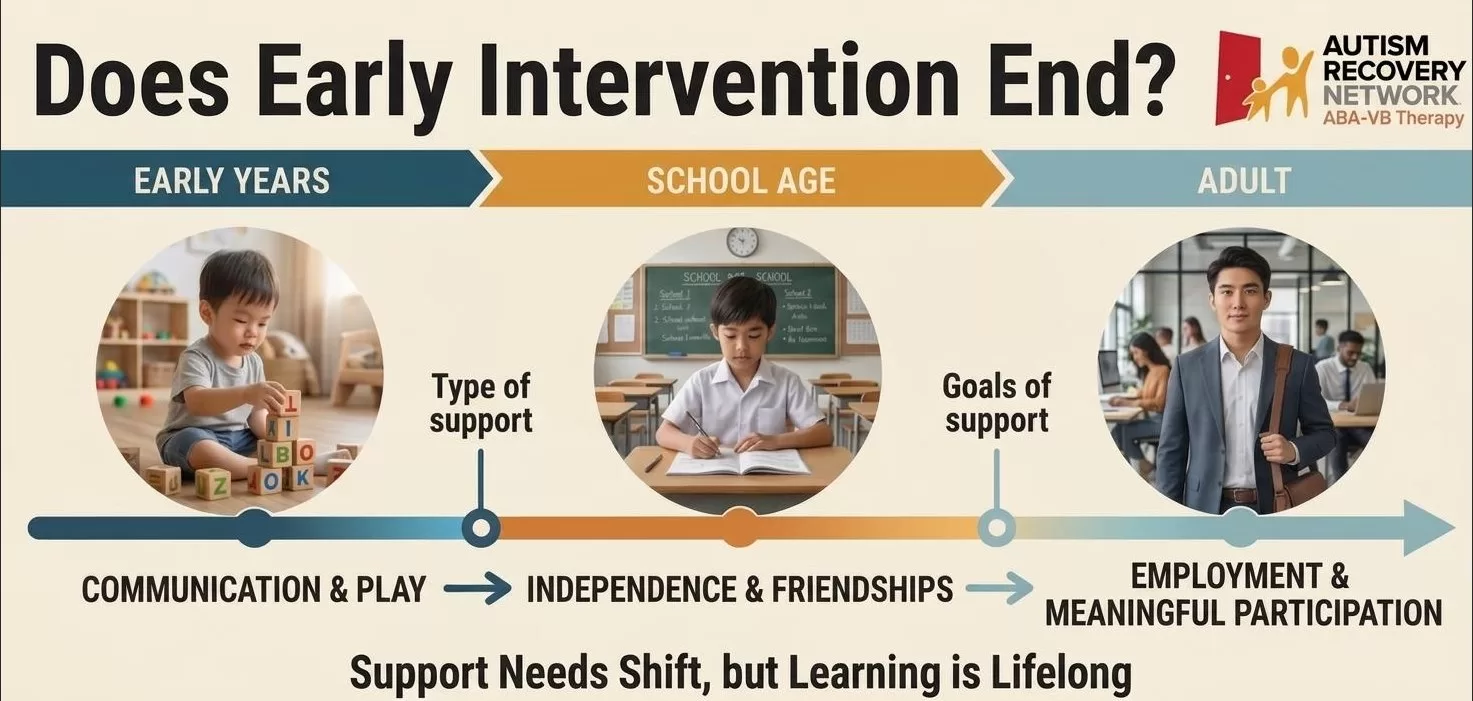
Early intervention may end as a programme, but a child’s support needs can change rather than simply disappear.
What Is Early Intervention?
Early intervention refers to services and support provided to young children with developmental delays or disabilities and their families. It may focus on communication, play, learning, movement, social interaction and everyday skills.
The CDC explains that early intervention can help young children develop new abilities and address developmental challenges during an important period of learning.
However, “early” does not mean that support suddenly becomes unnecessary when a child gets older.
Support Needs Change as Children Grow
A young child may need help with:
- Requesting wants and needs
- Playing with others
- Following simple instructions
- Daily routines
- Early learning skills
As the child grows, priorities may shift towards:
- Conversation and social interaction
- Friendships
- Emotional regulation
- Flexibility
- School participation
- Problem-solving
- Self-care
- Community and independent living skills
The child may therefore need different goals, rather than simply more of the same therapy.
The National Institute of Mental Health notes that autistic people have a wide range of needs and may benefit from different combinations of behavioural, educational, speech-language and other supports across life.
Intervention May Change Rather Than Simply Stop
A child who needed intensive support as a toddler may later require fewer therapy hours or a different type of intervention.
For example, goals may move from:
“Ask for a favourite toy”
to:
“Ask a teacher for clarification.”
Later, that might become:
“Communicate effectively with coworkers or unfamiliar people.”
Similarly, learning to follow a simple routine as a young child may eventually develop into organising homework, preparing food, travelling in the community or managing workplace responsibilities.
For autistic children, approaches such as Applied Behaviour Analysis (ABA) may be used to support communication, learning and everyday functioning when appropriate to the individual. The CDC notes that autism interventions can take place across home, educational and community settings, and that services may continue to support daily functioning and community participation as individuals grow older. CDC: Autism Treatment and Intervention
From Developmental Skills to Real-Life Independence
As children get older, it becomes increasingly important to ask:
“Can my child use this skill in everyday life?”
Learning something during therapy is only the first step.
A child who can ask for help with one therapist should gradually learn to ask other appropriate adults when support is needed.
A teenager who can calculate money on a worksheet should also learn how to use money when shopping.
A child who can tolerate a planned change during therapy should gradually practise handling changes at home, school and in the community.
Tools such as the Assessment of Functional Living Skills (AFLS) may be used by professionals to identify functional skills related to home life, school, community participation, vocational skills and independent living.
The longer-term goal is generalisation—using useful skills with different people, in different places and when they are actually needed.
Ask “What Does My Child Need Now?”
Instead of asking only:
“Is my child too old for early intervention?”
consider asking:
“What does my child need at this stage, and is the current support still helping?”
Parents and professionals can review:
- Is the child still making meaningful progress?
- Are the current goals appropriate for their age?
- Can skills be used outside therapy?
- Is the level of support still necessary?
- Could support be reduced, changed or redirected?
- What new skills will become important next?
Support should not continue simply because it has always been there. Equally, it should not stop simply because a child reaches a particular age.
What Is the Ultimate Goal?
The goal of intervention is not lifelong dependence on therapy.
It is to help children develop meaningful skills and become increasingly able to use those skills with less support.
For some children, a particular intervention may eventually no longer be necessary. For others, support may continue in a different form as new expectations emerge during school, adolescence and adulthood.
So rather than asking:
“When should intervention end?”
a better question may be:
“What skills does my child need next, and what level of support will help them become more independent?”
Not Sure What Support Your Child Needs Next?
If your child’s needs have changed and you are unsure whether their current programme still matches their stage of development, Autism Recovery Network offers a FREE 30-minute parent consultation with our Programme Supervisors.
Parents can discuss their child’s current communication, learning, social and daily-living skills, ask questions about changing priorities, and explore whether an individualised ABA-VB programme may support their next stage of development.
