Does your child eat the same few foods every day? Do they refuse a favourite food when the brand changes, avoid certain textures, or become very upset when a new food appears on their plate?
Many children go through a picky-eating stage. However, food selectivity in autism can be more persistent and complex.
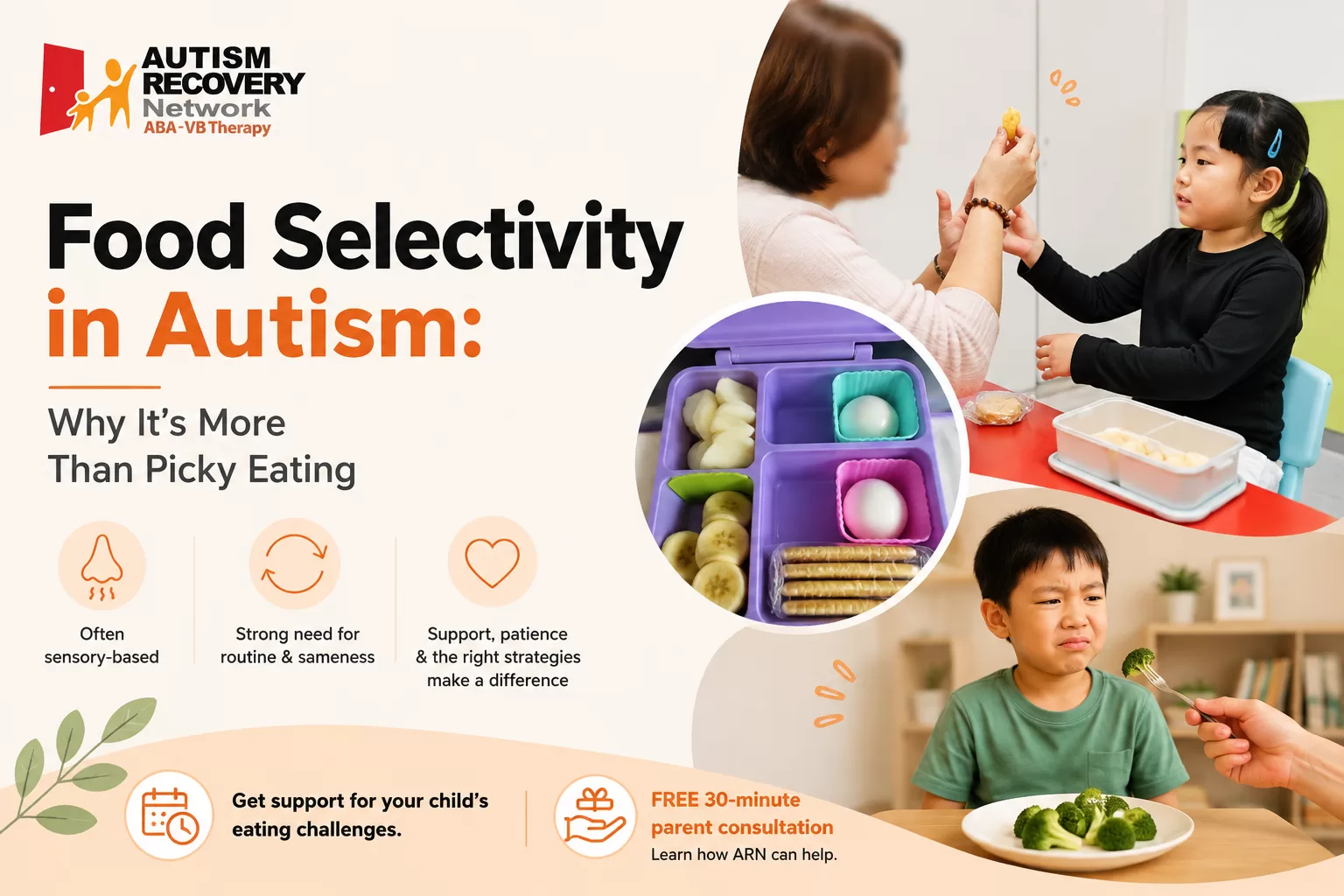
For autistic children, eating difficulties may be connected to sensory differences, anxiety, a strong preference for routine, feeding skills, or physical discomfort. Therefore, understanding why your child refuses food is often more helpful than simply trying to make them eat.
Research has consistently found that food selectivity is more common among autistic children than their neurotypical peers.
What Is Food Selectivity in Autism?
Food selectivity means consistently eating a limited range of foods or strongly avoiding particular textures, tastes, smells, temperatures, brands, or food groups.
It may look like:
- Eating the same foods every day
- Avoiding entire food groups
- Accepting only one particular brand
- Refusing food prepared differently
- Becoming distressed when familiar food looks different
- Refusing unfamiliar foods without tasting them
There is no single number of foods that separates ordinary picky eating from a feeding difficulty. Instead, parents should consider how restricted and persistent the eating pattern is and how much it affects nutrition and daily life.
1. Sensory Differences Can Affect Eating
Eating involves many senses at once: taste, smell, touch, sight, and even sound.
For some autistic children, certain sensory experiences can feel uncomfortable or overwhelming. Research has identified sensory sensitivity—particularly to food texture and taste—as an important factor in food selectivity among autistic children.
For example, a child may avoid:
- Soft or mushy foods
- Mixed textures
- Strong smells
- Sauces or wet foods
- Foods that are too hot or cold
- Foods touching each other
This may also explain why some children prefer crackers, nuggets, fries, or plain pasta. Packaged foods are usually predictable in appearance, flavour, and texture.
In comparison, a strawberry can be sweet today and sour tomorrow. For a child who depends on predictability, that difference can matter.
2. Routine and Rigidity May Influence Food Choices
Sometimes the difficulty is not the food itself—it is a change surrounding the food.
An autistic child may happily eat:
- One brand of yoghurt but refuse another
- Toast cut into squares but not triangles
- A familiar food at home but not at school
- Food from one particular bowl or plate
To adults, these differences may seem small. However, they can feel significant to the child.
Therefore, instead of assuming your child is being stubborn, ask:
“What has changed from my child’s point of view?”
This can help uncover the real reason behind the refusal.
3. New Foods Can Cause Genuine Distress
For some children, unfamiliar foods may lead to anxiety, crying, gagging, leaving the table, or pushing food away.
These reactions should not automatically be viewed as “bad behaviour.”
A child may dislike a particular texture, remember a previous unpleasant experience, or feel anxious because they do not know what the new food will taste like.
Repeatedly pressuring a child to “just take one bite” can sometimes make mealtimes even more stressful.
Instead, support should begin by understanding what is making eating difficult.
4. Feeding Difficulties Can Have Other Causes
Not every feeding difficulty in an autistic child is caused by sensory differences or behaviour.
Other factors can include:
- Difficulty chewing or swallowing
- Oral-motor difficulties
- Constipation or gastrointestinal discomfort
- Reflux
- Dental pain
- Food allergies
- Medication effects
- Anxiety
Professional feeding guidance recognises that feeding problems can involve medical, nutritional, feeding-skill, and psychosocial factors.
Therefore, persistent or severe food restriction should be assessed rather than treated as a behavioural problem alone.
Can Food Selectivity Affect Nutrition?
A restricted diet does not automatically mean that a child has a nutritional deficiency. However, consistently excluding multiple foods or entire food groups can increase nutritional risk.
NICE recommends assessing autistic children with restricted diets for feeding, growth, and nutritional concerns and referring for further support when needed.
Food selectivity can also affect everyday family life, including:
- School lunches
- Eating at restaurants
- Birthday parties
- Family meals
- Travelling
- Visiting relatives
Therefore, the goal is not simply to increase the number of foods a child eats. It is also to make eating safer, less stressful, and more manageable in everyday life.
How Can Parents Help Their Child Explore New Foods?
For some children, progress needs to happen gradually.
Instead of expecting the child to immediately eat a new food, small steps might include:
- Tolerating the food nearby
- Having it on the plate
- Touching or interacting with it
- Smelling it
- Trying a very small taste
- Gradually increasing acceptance
Behavioural approaches, including strategies based on Applied Behaviour Analysis (ABA), may be helpful for some children when they are individualised and appropriate to the reason behind the feeding difficulty.
Strategies may include gradual exposure, modelling, positive reinforcement, visual supports, and teaching communication skills such as asking for a break.
Importantly, medical, nutritional, sensory, and feeding-skill concerns should be considered before assuming that food refusal is purely behavioural.
When Should Parents Seek Professional Help?
Consider speaking with a professional if your child:
- Has an extremely restricted diet
- Continues to lose previously accepted foods
- Avoids entire food groups
- Experiences significant distress during meals
- Frequently coughs, chokes, or gags while eating
- Has difficulty chewing or swallowing
- Is losing weight or not growing as expected
- May have nutritional deficiencies
Depending on the concern, support may involve a paediatrician, dietitian, speech-language therapist, occupational therapist, behaviour therapist, or feeding specialist.
Picky Eating or Food Selectivity: What’s the Difference?
Ordinary picky eating is often temporary and mainly involves food preferences.
Food selectivity in autism may be more persistent and can involve sensory differences, anxiety, rigidity, feeding skills, medical factors, or learned patterns around mealtimes.
Most importantly, food refusal should not automatically be seen as defiance—and parents should not be blamed.
Instead of asking:
“Why won’t my child just eat?”
Try asking:
“What is making eating difficult for my child, and what support could make it easier?”
Understanding the reason behind the behaviour is often the best place to start.
Need Support With Your Child’s Eating Challenges?
If your child is experiencing persistent food selectivity, mealtime distress, or challenging behaviours around eating, professional support may help you better understand what is making mealtimes difficult. Autism Recovery Network (Hong Kong) offers a FREE 30-minute parent consultation to discuss your child’s needs, answer your questions, and explore how our team may be able to support your family.
