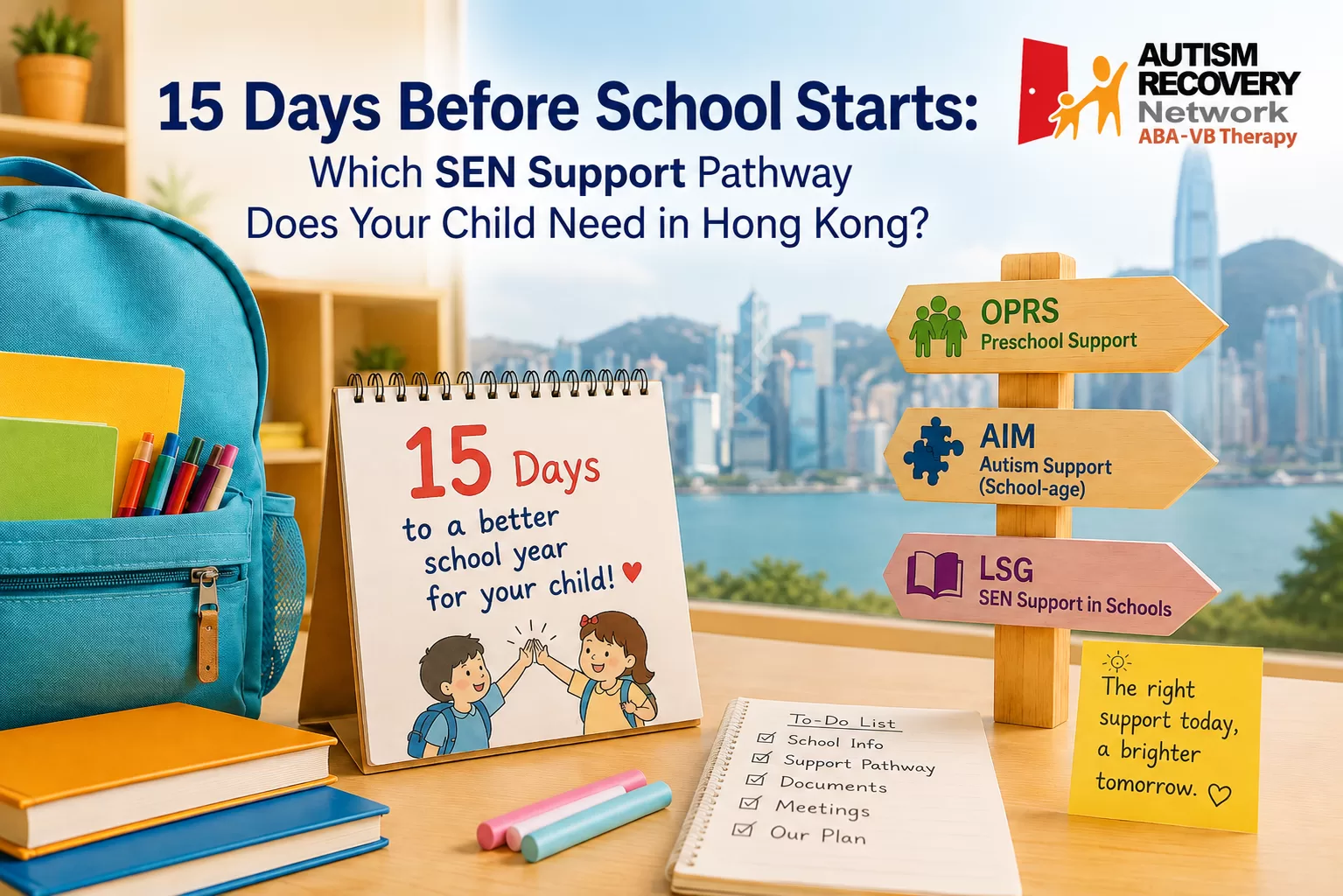
Two weeks before school starts, most parents are thinking about uniforms, books and school bags.
But if your child has autism or other special educational needs (SEN), there is another important question:
Which school support pathway applies to my child?
Hong Kong has different systems for preschool children and school-age students. Knowing the right pathway can help you ask better questions before the school year gets busy.
Start Here: Which Pathway Applies?
| Your Child | Main Pathway to Check | Ask the School |
|---|---|---|
| Preschool / kindergarten | OPRS + Tier 1 Support | Is my child receiving support, and what will it include? |
| Primary / secondary with autism | AIM Model | Which tier of AIM support applies to my child? |
| Primary / secondary with SEN | Whole School Approach + LSG | What SEN support is actually planned for my child? |
Pathway 1: Preschool — OPRS and Tier 1 Support
For children under six attending participating kindergartens, On-site Pre-school Rehabilitation Services (OPRS) provide school-based support for children with developmental needs.
Tier 1 Support Services also provide early intervention for children who are awaiting assessment, have borderline developmental difficulties, or are identified as showing early signs that they may need additional developmental support.
Hong Kong is also introducing a School-based Model of Pre-school Rehabilitation Services. Its trial began in April 2026 and expands to more kindergartens from September 2026, so arrangements may differ between schools.
Ask your kindergarten:
“What support will my child receive this year, what skills are being worked on, and how can we practise them at home?”
Parents should understand not only whether their child “receives therapy,” but also what is being taught and how progress will be monitored.
Pathway 2: School-Age Autism — Understand AIM
For students with autism in mainstream primary and secondary schools, parents may hear about the Tiered Autism Intervention Model (AIM).
AIM uses three levels of support:
- Tier 1: Autism-friendly classroom strategies and teaching support
- Tier 2: Additional small-group training
- Tier 3: More individualised support, including an Individual Education Plan (IEP) where appropriate
The model focuses on learning, social communication and emotional adaptation.
AIM support is delivered through two main approaches: school-based multidisciplinary professional support and NGO-school collaboration, which can include small-group social-adaptive training and consultation for teachers and parents.
Instead of asking only, “Does the school support autism?”, ask:
“Which AIM tier applies to my child, and what specific goals will be worked on this term?”
That gives you much more useful information.
Pathway 3: School-Age SEN — Understand the Learning Support Grant
For students with SEN in ordinary schools, you may also hear about the Learning Support Grant (LSG).
One important point:
LSG is not money given directly to an individual child.
Schools receive resources and deploy them flexibly according to students’ needs. These resources can help schools provide additional staff, intervention and other forms of SEN support.
So instead of asking:
“How much funding does my child receive?”
Ask:
“What support has the school planned for my child using its SEN resources?”
Why September to November Matters
Early in the school year, schools review SEN information and support arrangements.
After obtaining parental consent, schools can input or update students’ SEN information and required support tier in the Special Education Management Information System (SEMIS).
For relevant students, schools submit information through SEMIS, including assessment reports and IEPs where applicable, on or before 30 November so the EDB can calculate the school’s LSG entitlement.
Parent tip: If your child has a new diagnosis, assessment or professional report, give it to the school early and check that the school has the information it needs.
3 Documents Worth Asking About
Parents can also check:
- Summary of Support for Student — what support applies to your child
- School Profile — how the school implements its Whole School Approach to SEN
- School Report — the school’s SEN policies, resources and support measures
These help move the conversation from “Does the school provide SEN support?” to:
“What support specifically applies to my child?”
3 Meetings You May Encounter
You may also be invited to:
- Case meeting: Discuss concerns, progress and priorities
- Post-assessment meeting: Review assessment findings and recommended support
- IEP (Individualised Education Plan) meeting: Set and review individual goals for students requiring more intensive support
A useful question at any meeting is:
“What are the most important goals for my child, and how will we know if they are improving?”
School Support Is One Part of the Plan
School resources can provide valuable support, but they do not automatically mean unlimited one-to-one therapy or a fixed number of intervention hours.
Children may still need practice with communication, social interaction, emotional regulation, flexibility, independence and daily routines outside school.
The strongest approach is usually one where parents, school staff and outside professionals work toward consistent goals.
Your 15-Day Back-to-School Check
Before school starts, make sure you can answer these three questions:
- Which pathway applies to my child — OPRS, AIM or the wider SEN support system?
- Does the school have my child’s latest assessment information?
- Do I know the first priorities for this term and what we can practise at home?
Knowing the programme name is helpful.
Knowing what your child is actually learning—and how progress will be reviewed—is more important.
Not Sure Which Pathway Applies?
Autism Recovery Network (ARN) offers a FREE 30-minute Parent Consultation for families who would like to discuss their child’s school transition, development or areas that may need additional support.
Parents can discuss:
- School readiness and transitions
- Communication and social skills
- Behaviour and emotional regulation
- Independence and daily living
- Supporting school goals at home
Book a FREE 30-minute Parent Consultation with ARN to better understand your child’s needs and plan the next steps for the new school year.
Consultation is for parents only.
